
The growth stocks may grab the headlines, but they weren't the story in the third quarter. In our Q4 2026 Quarterly Market Report, BIP Wealth's Chief Investment Officer, Eric Cramer, CFP®, CFA®, checked in on our four key themes for 2026, explained what he calls a really underreported phenomenon in the stock market, and translated the post-midterm political shift into questions that matter for investors.
Here's a summary of Eric's main talking points. You can also watch the full recording of the presentation below.
Our Four Key Themes for 2026: A Check-In
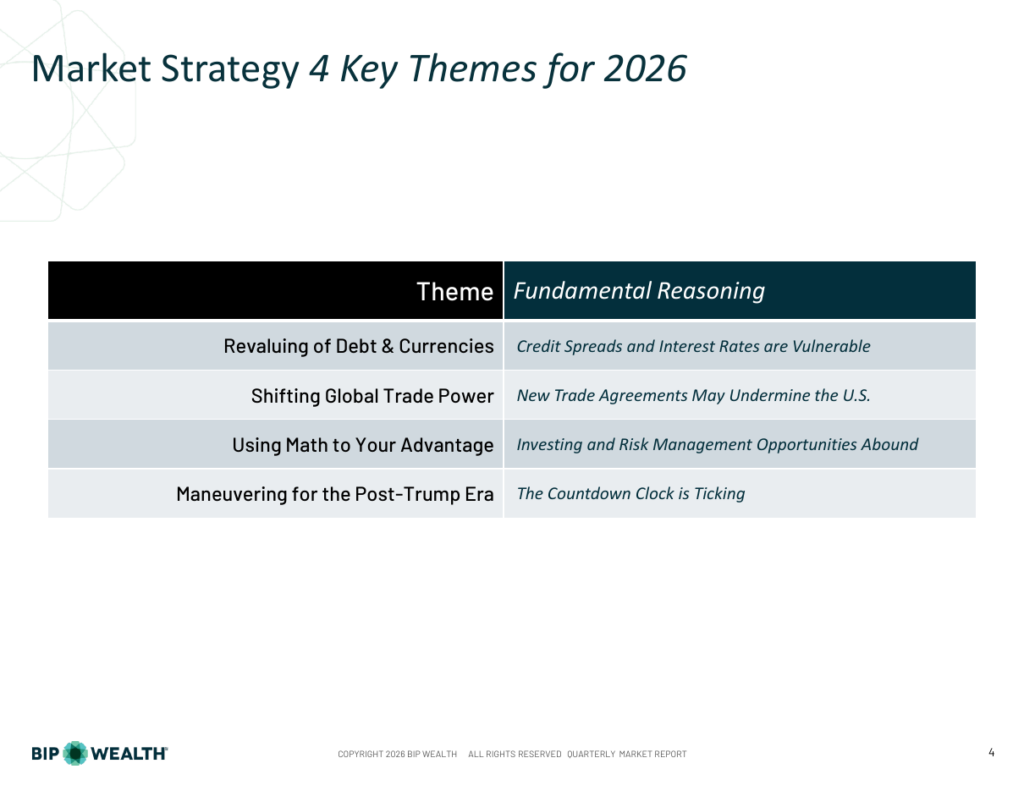
At the start of the year, Eric laid out four key themes for 2026. Looking back, he believes they identified what have become the year's most pressing issues.
Revaluing debt and currencies. Back in 2022, BIP Wealth made one of the biggest calls in the firm's history. Seeing inflation coming, we took nearly all the credit risk and interest-rate risk out of our fixed income approach. That year, the fixed income index fell 13%, by far its worst year ever, and that shift was designed to help clients avoid losses like those. We've largely held that stance since.
Shifting global trade power. A wave of new or updated trade agreements have been signed this year among other economies: Canada to Europe, Canada to Asia, Asia to Europe, South America to Europe. What they have in common is that they all leave out the U.S. Eric doesn't see a material impact yet, but it's one reason international stocks have done better than many expected. We've always kept a modest U.S. overweight, and we're watching the data to decide whether that still makes sense.
Using math to your advantage. From choices that affect life expectancy to whether it's worth paying a bit more tax now to move assets into a Roth account, the math behind your plan matters. If tax rates rise in the future, a Roth conversion may make sense for more people than you'd think.
Maneuvering for the post-Trump era. With the midterms behind us and a lame-duck presidency ahead, the maneuvering has begun. Eric expects that maneuvering to shape the legislative agenda in the year ahead. More on what that means for investors below.
Value Rallied, Again
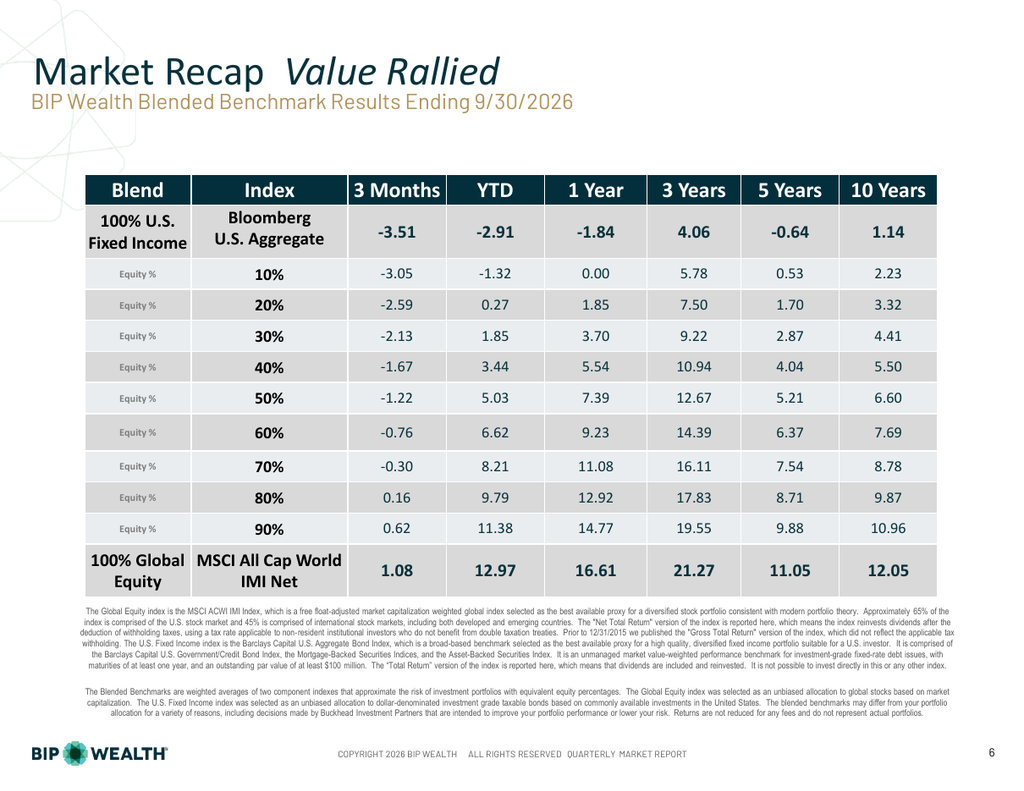
Source: MSCI, Bloomberg. For illustrative purposes only. Past performance is not a guarantee of future results. Returns are not reduced for any fees and do not represent actual portfolios.
The headline for Q3: value rallied. That's good news for our clients, because we hold a modest overweight to value stocks, and a smaller tilt toward small caps.
At the broad-market level, it was a calm quarter. The Global Equity Index returned 1.08% for the quarter and 12.97% year-to-date, with annualized returns of 11.05% over five years and 12.05% over 10 years. That's three to four percentage points more than Eric would expect in an average year, and more than he expects going forward.
"Even if we held on to the 12.97%, we would put that into the history books as a great year."
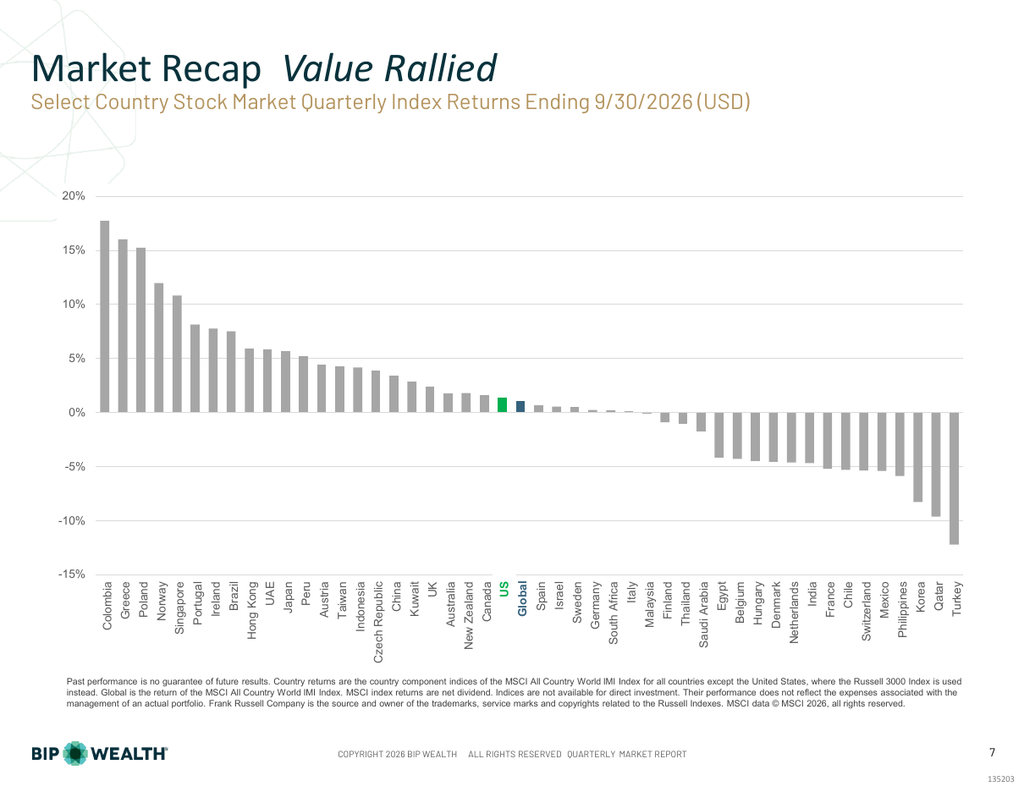
Source: MSCI All Country World IMI Index; Russell 3000 Index (U.S. proxy). For illustrative purposes only. Past performance is not a guarantee of future results.
U.S. and global returns were both, in Eric's word, boring. Dispersion across countries was wide (Colombia led, Turkey trailed), but for diversified U.S. investors, it was a very calm quarter.
The Underreported Story: Value Stocks
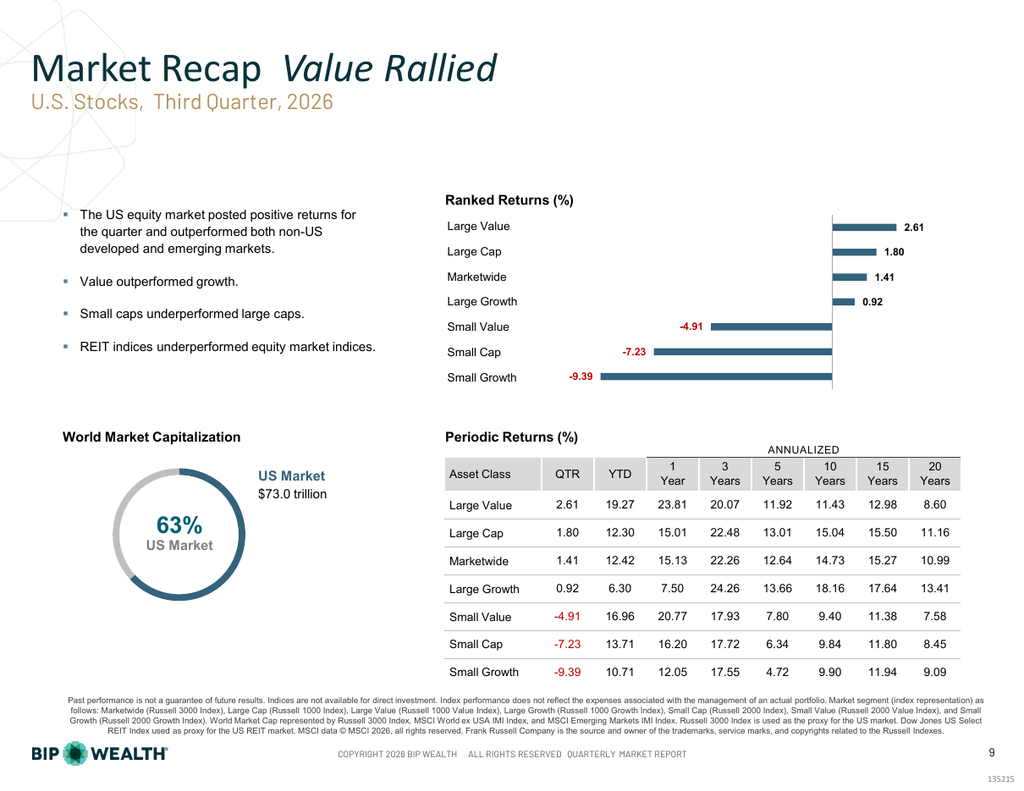
Source: Russell 1000, Russell 2000, and Russell 3000 indices; MSCI. For illustrative purposes only. Past performance is not a guarantee of future results. Indices are not available for direct investment.
Growth stocks get the headlines whether they're up or down 20% on any given day. But value stocks have been rallying for a few years now, and Q3 continued the trend.
- U.S.: Large Value led the quarter at +2.61%, while Small Growth fell 9.39%.
- International developed: Value (+3.71%) beat growth (-1.89%), and small caps beat large caps.
- Emerging markets: Value led again, returning 3.07% for the quarter and 26.78% year-to-date, and value has also led over the trailing one- and five-year periods.
Value stocks are, broadly, companies with strong current earnings expected to continue, while growth stocks are priced on earnings expected in the future. Over 10-, 15-, and 20-year periods, value has nearly always come out ahead, based on roughly 100 years of U.S. data and about 50 years of international data. Value can also trail growth for long stretches, so it's one tilt among many, not a guarantee.
"It's one of the overweights that you never know when it's going to work and when it's not, but if you look at five- and 10-year periods, it almost always works historically. That's why we're not indexers."
Emerging markets deserve a special note. After long stretches where they didn't seem to reward investors, they've been doing great: even after slipping 0.30% this quarter, the broad emerging markets index is up 22.04% year-to-date. Eric's takeaway: a little exposure to emerging markets alongside U.S. and developed-market stocks has been rewarding over the long run.
Fixed Income: A Brutal Quarter for the Index
Source: Bloomberg, Federal Reserve, S&P, and ICE BofA index data. For illustrative purposes only. Past performance is not a guarantee of future results. Indices are not available for direct investment.
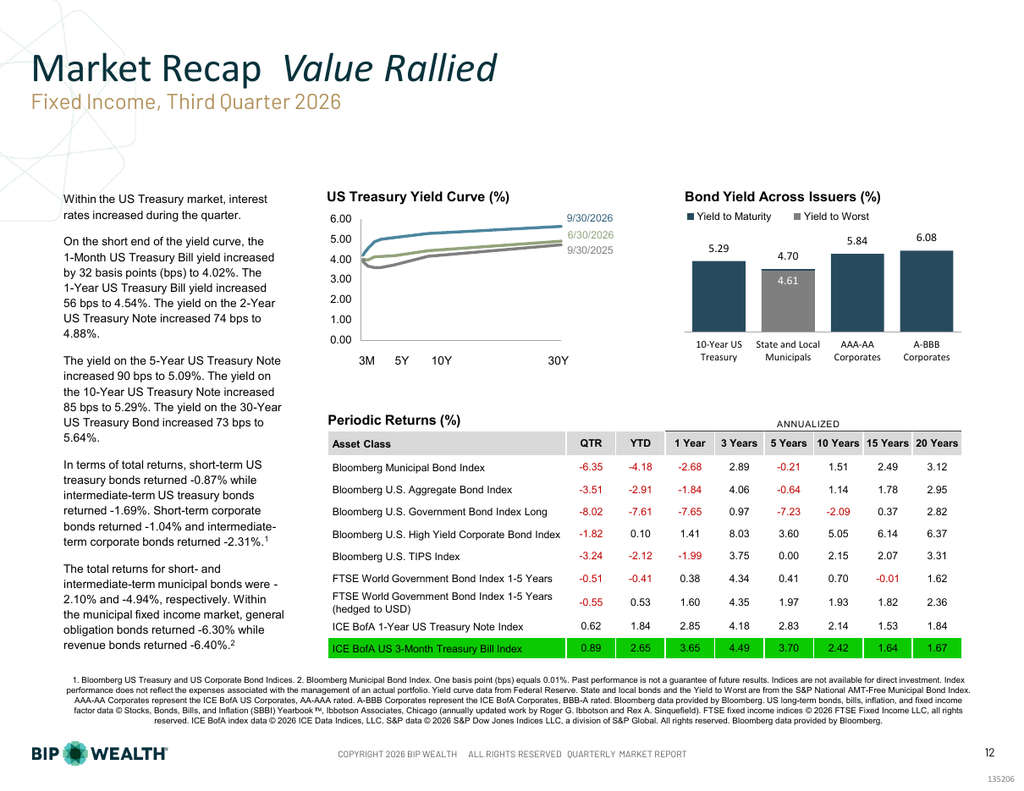
The U.S. Fixed Income Index fell 3.51% for the quarter, bringing its year-to-date return to roughly -3%. Its five-year average annual return is now -0.64%. For what's supposed to be the safe part of a portfolio, that's a problem.
Eric's reminder of how this happens: in early 2022, many banks locked in 10-year Treasuries at about 2%. By year-end, the going rate was closer to 5%, leaving them with a below-market deal for nine more years. When rates rise, bonds you already own lose value.
Why did yields jump so much in Q3? Inflation. Energy prices are at the heart of it, and many economists believe that even if energy markets returned to normal tomorrow, it would take years for that pressure to ease. When inflation expectations move, yields move with them: during the quarter, the 10-Year Treasury yield rose 85 basis points to 5.29%, and the 30-Year rose 73 basis points to 5.64%. Today, the federal government will pay just shy of 5.5% a year to borrow for 30 years.
"I love fixed income, because fixed income offers us this bit of math that the stock market doesn't. I've got the price for the next 30 years."
Source: ICE BofA government yield data. For illustrative purposes only.
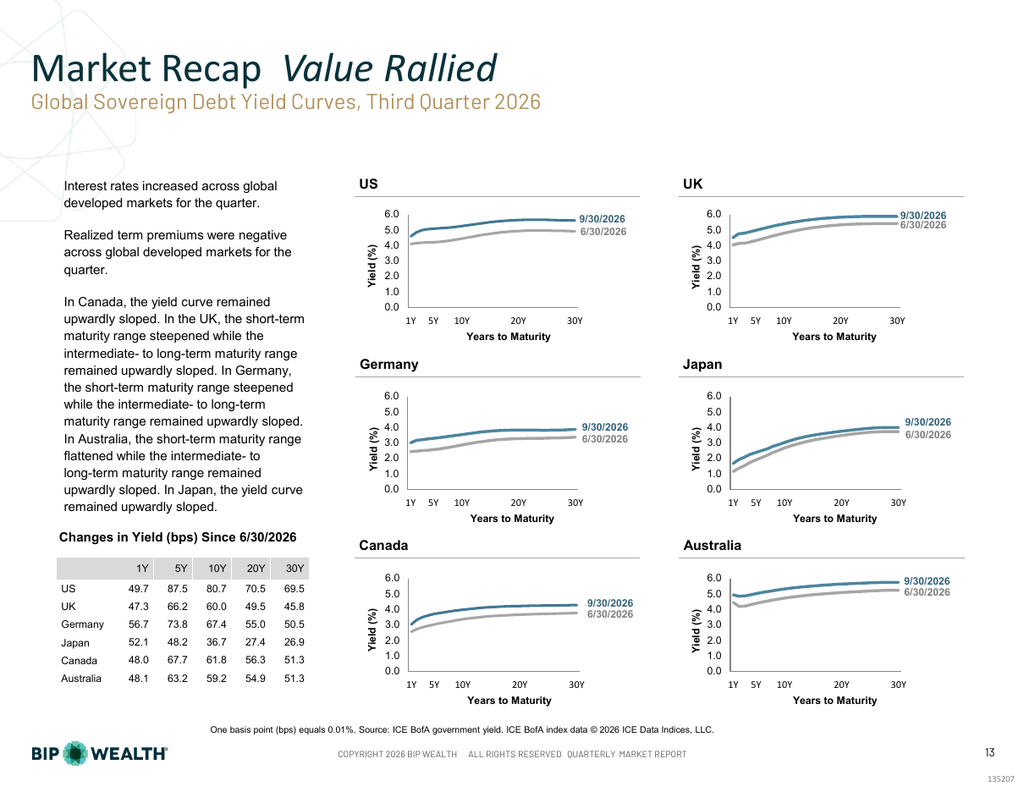
This wasn't just a U.S. story. Sovereign yields rose in the UK, Germany, Japan, Canada, and Australia too, because inflation, and the energy markets driving it, are global.
How we approach fixed income: The highlighted row on the slide, the ICE BofA US 3-Month Treasury Bill Index (+0.89% for the quarter, +2.65% year-to-date), most closely mirrors the core of BIP Wealth's public fixed income strategy. It's about as boring as an index gets, and that's the point: little credit risk and, done the right way, very little interest-rate risk. That's the approach we moved into in early 2022, and it still anchors our strategy today. Our private market and hedged yield strategies are designed to complement that core.
"Beating the fixed income index was a really, really hard thing to do as an investment advisor. But about five years ago, the data was just coming in that said we needed to take a very active stance."
The Election Signal Hiding in the Bond Market
Something odd happened after the quarter closed. Through the fall, 30-year Treasury yields had been climbing toward 6%. Then, about two to three weeks before the midterms, long-term rates began to collapse, from close to 5.8% to roughly 5.3% in a matter of days.
Eric couldn't find an explanation at the time. Inflation expectations hadn't fallen; if anything, they'd risen. After the election, he believes it became clear.
Here's his read: hyperscalers and data center builders have been financing the AI buildout by issuing debt, and much of that buildout is planned for Texas. Markets anticipated that a new Congress could bring more regulation and slow those projects. Less corporate borrowing means less competition for lenders' dollars, so the federal government could borrow more cheaply.
The lesson? With a crystal ball, investors who locked in 30-year bonds near 5.8% would have seen a meaningful price gain just days later (a hypothetical illustration, not an actual trade). Without one, it's a reminder that markets often price in what the headlines haven't caught up to yet.
Energy Is a Global Market, and It's Driving Inflation
Source: Bloomberg Commodity Total Return Index. For illustrative purposes only. Past performance is not a guarantee of future results.
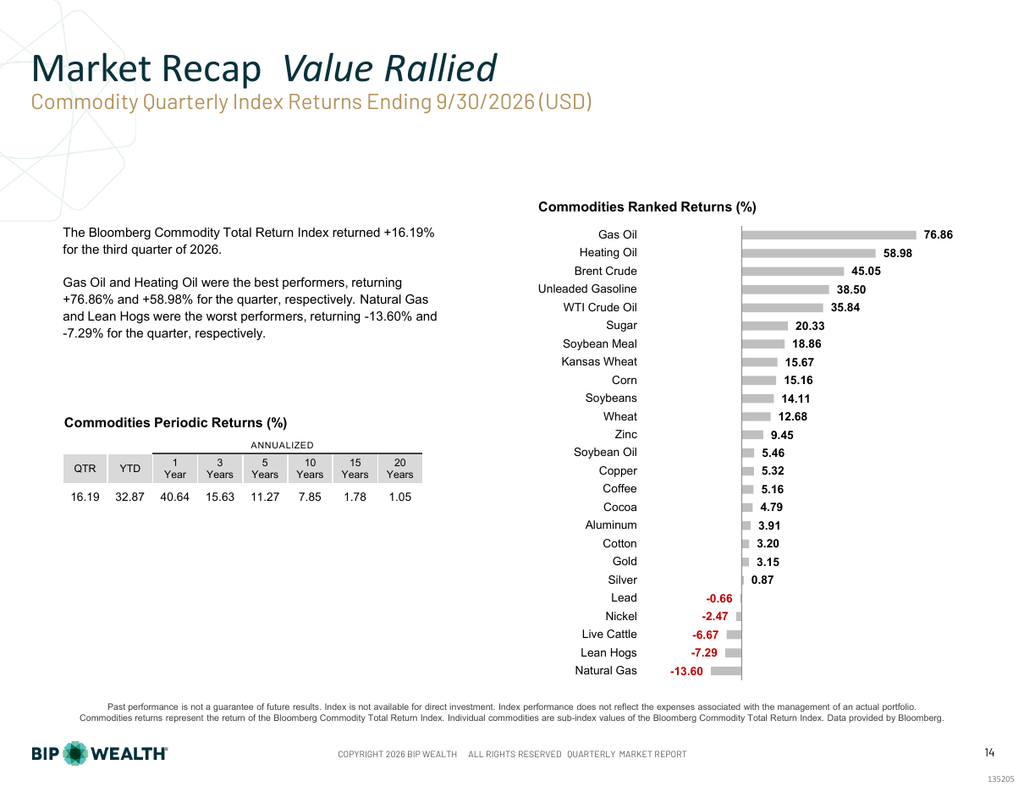
The Bloomberg Commodity Total Return Index, which is heavily weighted toward energy, is up about 40% over the last year and about 15% a year over the last three. It returned 16.19% in the third quarter alone. And with government data collection facing funding and staffing cuts, Eric leans on spot commodity prices (what a refiner pays for delivery today) to get a cleaner read on where inflation is headed.
A point Eric makes often: in the U.S., companies, not the government, produce our oil, gasoline, and diesel. Just as GM, Ford, BMW, and Hyundai build cars here, energy companies, domestic and foreign, produce energy here. They're profit-seeking, and they sell at the global price. So if diesel costs more in Japan, it costs more here too. Eric goes deeper on this in a recent blog on the energy markets.
Why does this matter beyond the gas pump? If energy stays expensive for long, everything gets more expensive: the computer you're reading this on, new furniture, carpet. Even the information economy isn't immune, since data centers use massive amounts of energy. That's why "core" inflation, which excludes food and energy, can understate the pressure.
One oddity: natural gas got cheaper. It fell 13.60% for the quarter. Much of it comes out of oil wells, and expensive oil gives drillers every reason to drill new ones. A year ago, cheap oil had the opposite effect.
"Even if we somehow snapped our fingers and went back to where the markets were a year ago, two years ago, three years ago, we're going to have this inflationary pressure for several years to come."
The Political Shift: Putting On Our Investor Hat
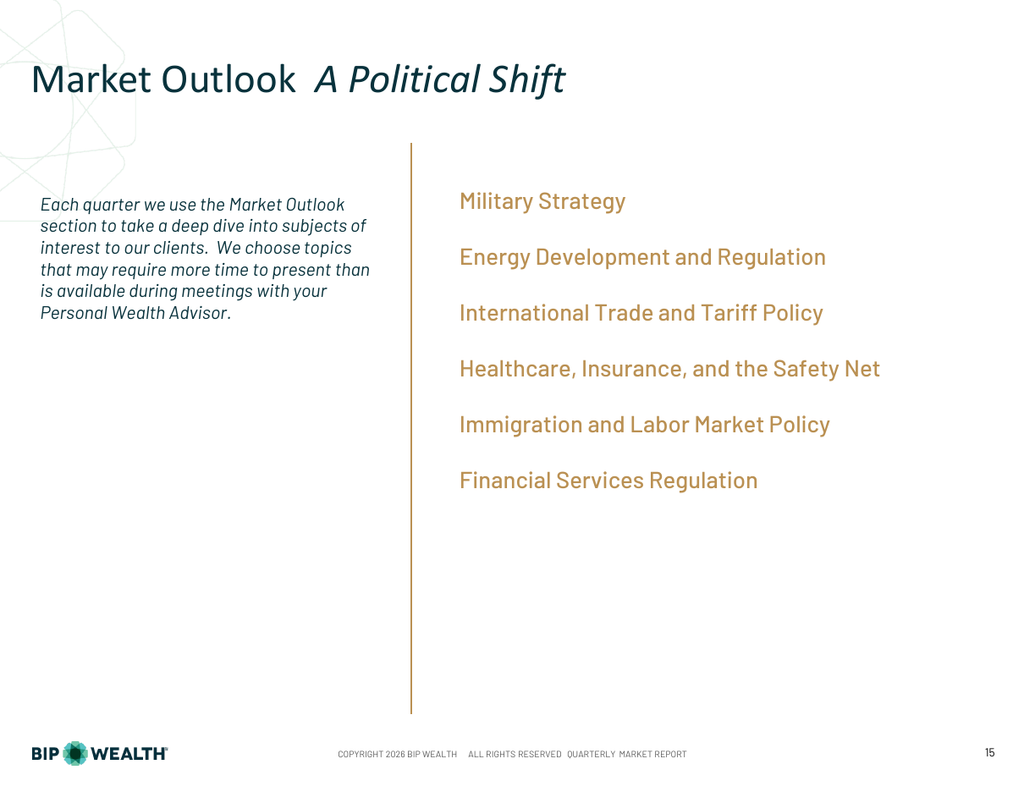
Eric was clear that this isn't about taking a political side. Instead, he walked through the issues nonpartisan pollsters found motivated voters in the midterms, and the questions each raises for investors. As he put it, he has more questions than answers right now, but these are the ones we're watching.
For each issue, the same five investing questions apply: the federal budget and national debt, consumer inflation, sector spending priorities, innovation versus regulation, and legal and security stability.
- Military strategy. Questions about NATO, Ukraine, Russia, and the Middle East are all in play, and the Middle East conflict has hit energy markets hard. Rebuilding bases and restocking munitions could cost well over $1 trillion by some estimates. For investors, that raises questions about inflation, the federal budget, the national debt, and the interest rate the government will have to pay to borrow. China is watching too, with Taiwan in the background.
- Energy development and regulation. Electricity is priced by what's called the merit order. As demand rises, the grid pulls from the cheapest source first (wind and solar), then nuclear, then coal and oil, and finally gas turbines that run only at peak. Everyone pays the price of the last, most expensive watt added. Remove cheaper sources, and prices climb faster. Eric also sees real promise in small modular nuclear reactors, if innovation is rewarded and regulation becomes more manageable.
- International trade and tariffs. Many tariffs were ruled illegal and money was rebated, though new tariffs may follow. Rolling some back could ease inflation pressure, but Eric expects a clearer picture once the new Congress sets its agenda.
- Healthcare, insurance, and the safety net. These debates go back at least to 1972, when President Nixon promised to fix health care. Meanwhile, AI that reads our genetic code to tailor treatments is already being funded, and that could be a major investment opportunity.
- Immigration and labor market policy. Until recently, a shortage of workers limited U.S. growth. Now AI could reshape the labor market in either direction, from shorter work weeks to much longer careers if life expectancy rises.
- Financial services regulation. A large share of Americans don't own a single share of stock, and many of them are unbanked. That's a reminder that the U.S. isn't monolithic, and that this issue carries both risks and opportunities.
"All of these things present risks, but they all present investing opportunities, if you think about it long enough."
If there's one place Eric is confident, it's this: we remain very concerned about inflation, and we think the pressure will be with us for years.
Final Thoughts
Elections can be a turning point. Democracies always feel stress around elections, and these midterms were no different. Shifts like this one have become common in the years between presidential elections, but we don't yet know what will change as a result. We're watching, thinking, and calculating, ready in case it's time to make another big market call like the one we made on fixed income in 2022.
We are investors. Our focus isn't politics. It's understanding the results well enough to make good investing decisions, and it's likely still too early to start making predictions.
The future will keep changing. Like the results or not, there will be more elections. Investors can't afford to become paralyzed by current events. The most important choices are to stay diversified and to use measurable risk controls, and from there we can personalize how your money is put at risk to more likely achieve the outcome you need.
That might mean a new strategy for your lower-risk money, an opportunity in the private markets, or a lower-risk allocation because you don't need to take as much risk. Our core message hasn't changed: stay diversified, stay open to change, and let the data, not the headlines, guide your decisions.
If you have questions about how any of this applies to your situation, reach out to connect with a BIP Personal Wealth advisor.
BIP Wealth, LLC (“BIP Wealth”) offers investment advisory services and is registered with the U.S. Securities and Exchange Commission (“SEC”). Registration with the SEC as a registered investment adviser does not imply a certain level of skill or training. For more information about BIP Wealth, please refer to our Form ADV, available at adviserinfo.sec.gov or upon request.
This blog is provided for informational purposes only. Specific investments may not be suitable for all investors and no offer or recommendation of any investment or investing strategy is intended or implied by your choosing to read this blog. Past performance is no guarantee of future results. All investments involve risks including loss of principal.
This material is not intended to be relied upon as a forecast or investment advice regarding a particular investment or the markets in general, nor is it intended to predict or depict the performance of any investment. The opinions in this commentary are as of a specific date and are subject to change. Information has been obtained from third-party sources we consider reliable, but we do not guarantee the facts cited are accurate or complete.