BIP Wealth, recently named on wealthmanagement.com’s RIA Edge 100, as well as the top 3 on the Atlanta Business Chronicle’s 2023 Best Places to Work list for medium-sized companies, is proud to welcome the addition of former MLB outfielder Jeremy Hermida to its Baseball Division as Business Development Officer. Hermida joins former Pro Baseball players Kyle Schimdt, CFP®; John Hester, CFP®; and Chase Murray in the Baseball Division founded by former Major League Baseball pitcher Jim Poole.
Hermida was the Marlins' No. 1 draft pick (11th overall) in the 2002 Major League Baseball draft and one of the highest-rated minor league players throughout his 3-year ascent to the MLB. He went on to play professionally for 14 years, 6 of which were in the majors for the Florida Marlins, Boston Red Sox, Oakland Athletics, Cincinnati Reds, and San Diego Padres. He ended his professional playing career in 2015 in Japan with the Hokkaido Nippon Ham Fighters.
Having Jim Poole as one of his personal and professional mentors for 7+ years, Hermida knew he wanted to be more involved with the Baseball Division at BIP Wealth. With his deep admiration and firsthand knowledge of the importance of having exquisite financial advice and guidance, it was an easy ‘yes’ for Hermida to move from being a client of BIP to joining the team. He considers his current role both an honor and a calling.
BIP Wealth’s Baseball Division provides investment management and sophisticated planning solutions geared towards the goals and objectives of draft-eligible, current, and retired professional baseball players and their families. Hermida is uniquely positioned to help guide clients through their journey of life on and off the field.
“BIP is in a class of its own when it comes to client care and expertise, and I am thrilled to be a part of the team,” said Hermida. “Being mentored by Jim Poole helped lead me to where I am today on the team. I started with a few private investment deals as a hobby and became more and more interested after my playing days. I’m so ready for this second career and the chance to take a more hands-on approach to guiding current and former players and their families as they prepare for the future.”
“Jeremy has been a part of the BIP Wealth family for the past 7 years as a client. We’re excited that he’s decided to take this next step in his post-playing life by joining our Baseball Division,” shared Bill Harris, CFP®, Co-Founder & CEO of BIP Wealth. “Jeremy has played baseball all over the world, so he knows first-hand the ups and downs of a professional career. His extensive playing experience and financial aptitude will be a strong addition to our team. The future success of BIP Wealth’s Baseball Divison just took a big step forward.”
Hermida lives in the Dunwoody area with his wife of 12 years, Lindsey, and their son and two daughters. Born and raised in Marietta, Hermida went and married a northern Jersey girl, so you can find them splitting their summer vacations between the south and the north.
Contact Jeremy: Jeremy Hermida, BIP Wealth Baseball Division, Business Development Officer
Press Contact: Jenni Brown, Chief Marketing Officer
When planning for your financial future, there are a number of routes you and your loved ones can take. Two of those routes are portfolio and wealth management. At first glance, they may seem very similar, but the two are significantly different from each other.
Portfolio management, also referred to as asset management, serves as a focused investment strategy, where investors seek to see the best possible returns while balancing risk. Wealth management, on the other hand, is a much more holistic approach, often involving everything from investments to retirement planning.
So, what differentiates portfolio vs. wealth management? And which option is right for you? In this blog, we’ll break it all down.
Let’s start the portfolio vs. wealth management discussion by first breaking down the main characteristics of each option. Both portfolio and wealth management present clients with a unique financial plan. In portfolio management, it’s important to consider risk versus reward. This is a focused, targeted approach in which investors invest in assets to try and secure the highest possible returns while managing their overall portfolio risk.
There are four different types of portfolio management. Active, passive, discretionary, and non-discretionary. In active portfolio management, the goal is to achieve higher returns than the market benchmark. In passive portfolio management, the goal is to match an index or benchmark’s performance. Discretionary and non-discretionary portfolio management deal with a portfolio manager’s ability to make decisions about an investor’s holding with or without their insights. Ultimately, the goal is the same: grow an investor’s portfolio through assets such as stocks.

A portfolio manager will typically be tasked with making investment decisions, managing assets, and ensuring that investments align with the established objectives and strategy. They analyze market trends and investment opportunities to make informed decisions that will contribute to the financial growth of the client.
In a discretionary arrangement, the manager can make decisions for their client without the need for ongoing authorization. In a non-discretionary arrangement, the client will reserve the right to accept or decline any potential strategy that their portfolio manager suggests.
When comparing wealth management vs. portfolio management, wealth management is much more comprehensive. This financial strategy encompasses a much wider range of services to better tailor the right approach to a client’s specific needs or long-term goals. It goes beyond investment strategies to grow and safeguard a client’s wealth over time. For example, a portfolio manager may reinvest funds from one stock to another while a wealth manager may complete the same step while also setting aside funds for a client’s retirement fund.
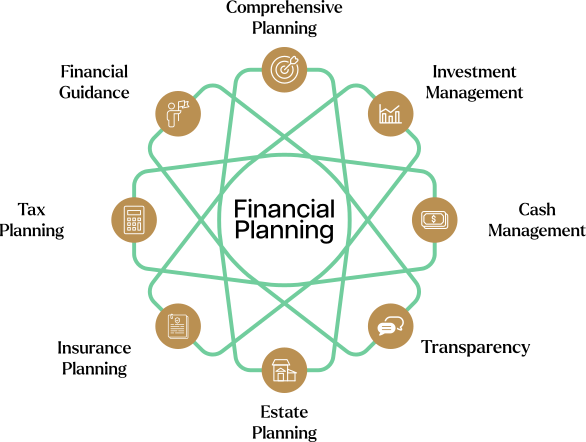
There are five core elements of a well-run wealth management strategy. The first is financial planning to reach both short and long-term goals. Asset allocation is the second, in which clients are given tailored strategies based on their goals and willingness to take risks. The third is asset management. Finally, four and five are estate and tax planning. Together, these five core elements make up a true holistic wealth plan for clients.
To put it simply, a wealth manager wears a lot of hats. They assess a client’s entire financial situation and devise a comprehensive strategy to meet the client’s goals. Their role involves continuous monitoring and adjustment of the financial plan to ensure it remains aligned with the client’s objectives, changing life circumstances, and market conditions. When the unexpected happens, a wealth manager must be ready to spring into action to help their clients navigate any newfound financial circumstances.
So, now that we’ve established what makes each strategy different, you might be wondering which option could be best for you. When analyzing portfolio vs. wealth management, it’s important to first ask yourself what your goal is. Are you looking for a short-term or a long-term financial plan? If you said the former, portfolio management may be the way to go. If you answered the latter, wealth management may be the better fit for you and your family.
It’s also important to consider how much risk you’re willing to take on as part of your financial and investment plans. Consider your goals and how you want to achieve them. We should note that neither portfolio nor wealth management strategies can ever guarantee returns. Always consult with a financial expert before rushing into any decision.
If portfolio and wealth management are on your radar, our team is ready to help you plan for the future. At BIP Wealth, we’re engineered to perform for you. Think of us as having your own personal CFO. We work closely with each client to create personalized plans based on empirical research with savvy integrations of alternative investments to help clients gain access to investment opportunities historically saved for just the upper class. Through family-style wealth management, including comprehensive estate, tax, and investment planning, our experienced team aims to foster a sense of belonging for each client. To learn more about our services, visit our financial planning page. You can also contact us to get in touch with one of our wealth managers.
What are the four types of portfolio management?
The four types of portfolio management are active, passive, discretionary, and non-discretionary.
What is the difference between portfolio and wealth management?
Portfolio vs. wealth management comes down to the level of services. Portfolio management focuses on assets and investments while wealth management focuses on long-term holistic wealth plans.
What is the difference between a financial advisor and a portfolio manager?
A financial advisor generally provides a broad range of financial planning and investment services to clients, while a portfolio manager tends to focus specifically on investments.
This communication contains general investing information that is not suitable for everyone and is subject to change without notice. Past performance is no guarantee of future results and there is no guarantee that any views and opinions expressed will come to pass. The information contained herein should not be construed as personalized investment advice, tax advice, or financial planning advice, and should not be considered a solicitation to buy or sell any security. Investing in the stock market and the bond market involves gains and losses and may not be suitable for all investors. Indices are not available for direct investment.
Author: Eric Cramer, CFP®, CFA®
If you’ve ever gone through the financial and investment planning process, you might remember that it took some effort. But you might look back at that investment in time and feel some sense of satisfaction that you did something for yourself and your family. Unfortunately, investment planning may be extremely dangerous to your financial health. Here are the top five reasons why:
How many working people can look back a decade and say that they would have accurately predicted their current income level? Fortunes change, people lose their jobs, people get promoted, and the future is unknown for most of us. Because of this, future earnings become one of the biggest financial planning mistakes people may make. If your financial plan assumes you have a healthy income for decades into the future, but that doesn’t happen, do you expect your retirement lifestyle to be the same? Anyone more than ten years from their planned retirement needs to understand why a certain income figure was used in their plan, and they might want to make their income estimates extremely conservative just to test for problems with their plan. A good advisor may even run more than one plan, using different income levels, to examine the sensitivity of the plan to this input. Another technique used for people approaching retirement is to assume that all income ends in the current year. This helps establish what your “worst-case scenario” may look like and every year of additional income just makes things better.
Life expectancy is a tricky thing for anyone to predict. The best investment planning probably assumes a very long life expectancy, because outliving your money is the biggest risk most people face. Avoiding "superannuation" is the main motivation for many people to engage in investment planning, which is why some planners may suggest using a life expectancy that you only have a 10% chance of achieving. This doesn’t mean that this estimate is more accurate, it simply provides a more prudent way to think about how to plan.
If your investment planning doesn’t address the concept of investment expenses, then you may need to ask some questions. Another big financial planning mistake you can make is not taking into consideration what you’re paying in fees and even taxes on investments. For example, your stock broker may start to crank out financial plans that use index returns to predict portfolio returns. But the reality may be that your investment accounts become full of high-cost mutual funds, annuities, and other fee-laden investment products that may not be able to quickly adjust to market shifts. It isn’t unheard of for an investor to pay more than 2% in total investment expenses (and sometimes much higher) while relying on a financial plan that assumes there are zero investment expenses. For a $1 million portfolio, that’s $20K per year that doesn’t compound. If you don’t think investment expenses are a big deal then consider this: at the end of 2017, the average annual return of the MSCI ACWI IMI Global Equity Index for the prior ten years was only 4.97. And the Bloomberg-Barclays U.S. Aggregate Fixed Income Index return over that decade was only 4.01%. If your portfolio was paying an extra 2% in fees then, depending on your allocation, you may have barely kept half of your returns. At the end of the day, your investment expenses really do matter.
Taxes are boring, yes, so let us tease you with this idea: if you own an actively traded mutual fund, and it realizes short-term capital gains (from selling stock it owned less than a year), then the fund has to distribute those gains to you along with a tax on the investments. Your investment planning advisor may not see it coming, and there may be little you can do to stop it. To make matters worse, the distribution that hits your account will now be taxed at your highest marginal rate (because it’s a short-term gain). On top of this, distributed short-term capital gains cannot be offset with realized capital losses. So, if your super stock-picking mutual fund was up 20% in a big year, but sold most of its holdings to reposition, maybe you had 10% distributed to you at a tax cost of around 4-5%. Suddenly that terrific 20% turns into only 15%. The big pothole here is when a fund has a down year, but still sells some winners, and you pay investment taxes on a negative return! It’s happened before and it will surely happen again. Will you make this common financial planning mistake?
Some investors won’t need Social Security to have a terrific retirement, but for most of us, it will at least play an important role. And here’s the thing: Social Security has its risks. It’s not hard to be cynical about this program run by the Federal Government, but in the interest of giving respect where it’s due, the Trustees responsible for running this giant entitlement program write some of the best financial reports you will ever read. They have been telling us for years that there are major Social Security risks ahead, and it’s getting closer to reality. In the 2023 Annual Report, it was estimated that in all likelihood the program will exhaust itself by 2033. At that point, they estimate, benefits will have to be cut by 23% to match annual tax collections. We can’t know how our current and future politicians will address this problem, but if your investment planning isn’t assuming a cut to your currently legislated benefits, you may be counting on money that you will never receive.
At BIP Wealth, we focus on holistic wealth management to help our clients fortify long-term success and avoid the common financial planning mistakes you read about above. To learn more about our services, check out our What We Do page. If you’d like to get in touch with one of our wealth advisors, feel free to contact us!
How do I estimate future earnings?
Although it is very difficult to accurately predict your future earnings, it may be helpful to create more than one investment plan to determine what your financial situation could look like in different scenarios.
What is superannuation?
Superannuation refers to a retirement savings system in which individuals set aside a portion of their income during their working years to fund their retirement. It is commonly known as a pension or retirement fund.
What is an investment expense?
Investment expenses refer to the costs associated with managing and maintaining an investment portfolio. These could include advisor fees, taxes, and operating expenses.
When do you pay taxes on stocks?
Taxes on investments like stocks are typically realized when you sell them for a net gain or loss.
Is Social Security at risk?
In a recent estimation, it was said that Social Security could exhaust itself by 2033, resulting in a 23% benefits cut.
This communication contains general investing information that is not suitable for everyone and is subject to change without notice. Past performance is no guarantee of future results and there is no guarantee that any views and opinions expressed will come to pass. The information contained herein should not be construed as personalized investment advice, tax advice, or financial planning advice, and should not be considered a solicitation to buy or sell any security. Investing in the stock market and the bond market involves gains and losses and may not be suitable for all investors. Indices are not available for direct investment.
BIP Wealth, one of the Southeast’s premiere wealth management firms, announced the addition of Chase Murray to its Baseball Division as Business Development Officer. Murray, who played professionally in the Pittsburgh Pirates organization, joins former Pro Ball Players Kyle Schimdt, CFP®, a former pitcher in the Orioles organization; and John Hester, CFP®, a former MLB catcher and professional scout; in the Baseball Division founded by former Major League Baseball relief pitcher Jim Poole.
BIP Wealth’s Baseball Division has extensive experience in wealth management geared towards the unique challenges and needs of ball players and their families. As a former player himself, Murray knows firsthand what his clients may face on and off the field.
Murray was previously a Global Enterprise Business Development Representative with Salesforce. He’s actively involved with his alma mater’s Alumni Association—Georgia Tech.
“We have a unique opportunity here at BIP Wealth’s Baseball Division to make a real impact in our clients’ lives from draft day to life after baseball,” said Murray. “Going through that transition myself to life off the field, I really enjoy being in a position to assist our current players and their familes as they make sound financial decisions for the future. I love being a resource to our clients, helping them in any way I can.”
“Adding Chase to our team has made an immediate impact,” said Kyle Schmidt, Personal Wealth Advisor, CFP® from the BIP Wealth Baseball Division. “As a fellow Yellow Jacket who played professional baseball, Chase, like few others, has walked this unique career path our clients are walking. He understands the opportunities, challenges, and complexities that come from playing the game we all love so much. We’re so excited to grow our team with the addition of Chase.”
Murray is based in Atlanta, GA, out of BIP’s Alpharetta office. Outside of work, he enjoys spending time with his family and friends, including his girlfriend Jenny, and lively boxer puppy Lola. He also enjoys watching sports—especially football—and trying desperately to turn his baseball swing into a decent golf swing. The BIP Wealth Baseball Division serves draft-eligible, current, and retired professional baseball players and their families.
Contact Chase: Chase Murray, BIP Wealth Baseball Division, Business Development Officer
Press Contact: Jenni Brown, Chief Marketing Officer
###
Creating and maintaining an investment portfolio that provides the best risk/return profile is the obsession of many investors. More return with less risk is obviously the goal. The stakes are high, which is why professionals and academics alike get into heated debates about competing models. A model that produces return results superior to others by mere fractions of a percentage point without more risk is considered a resounding success. That’s all good for investors, but sometimes it just isn’t the most important issue. That’s where Roth IRA strategies come into play. In this blog, we’ll explain how Roth IRA strategies, including Roth Simple IRAs can benefit investors.
In the real world (as opposed to a deliberately simplified financial model), the tax drag caused by investing decisions can have a much greater effect on the investor’s after-tax investment return. After-tax return is the money left over after taxes are paid that can actually be spent, and different types of investment accounts offer different tax treatments for different assets. For instance, capital gains earned within a traditional IRA (where distributions are taxed at the investor’s marginal income tax rate) may face twice the tax drag once distributed from the IRA when compared to a taxable account (where long-term capital gains receive a preferential rate). Traditional IRAs do provide for tax deferral (no taxes due along the way on income or gains earned) and many times the dollars inside our IRAs came from tax-deductible contributions either to the IRA or the 401k while we accumulating those dollars, so there are benefits for consideration in asset location and utilization for these pre-tax and tax deferral strategies within our overall plan to maximize our after-tax returns. All too often investment managers ignore the practical realities involved in maximizing the after-tax investment return through an asset location strategy.
When an investment manager can create a higher after-tax return for investors by minimizing tax drag, that’s referred to as “tax alpha” (where alpha means more return without more risk). Roth IRA strategies, when done right, are the holy grail of investment accounts if the goal is to increase tax alpha. If handled properly, Roth IRA conversions may never face any taxes. In the years since 1998, when the Roth IRA was launched, Congress has steadily liberalized the constraints that prevent many affluent investors from making Roth IRA strategies a large percentage of their portfolio.
This steady change in the tax rules has meant that investment managers can create more tax alpha for their clients if they are aware of all the techniques at their disposal. Sometimes this requires close coordination with a client’s tax advisor. Still, these generally aren’t considered risky maneuvers and a good tax advisor usually gets pretty excited to see that their client is working with an investment manager who isn’t making the tax bill even higher than it should be.
The most basic technique for increasing the amount of assets in a Roth IRA strategy is for the investor to make contributions each year. The investor, or their spouse, must have compensation for the year, so investors in retirement are usually out of luck. As of 2023, the contribution limit is up to $6500, with folks 50 and over able to add an additional $1000 as a “catch-up” contribution. This contribution limit is increased to $7000 for 2024, with the “catch-up” contribution for folks 50 and over remaining at the additional $1000.
Many employer-sponsored 401ks now also offer the ability to make Roth contributions, where the deferral limits for employees are $22,500 for 2023 and $23,000 for 2024, with the “catch-up” amounts for folks 50 and over being $7500. It's worth noting that there may be ways for you to make contributions above these levels on an after-tax basis depending on your specific plan and how much your employer contributes to your plan in the form of matching. These details are a touch more complicated as the IRS has limits on how much can be contributed in total to an individual’s 401k. We’ve touched on this in a previous post and won’t walk through the full details here since we are focusing on IRAs.
The biggest change to help affluent investors was when the income limits for Roth “conversions” went away. When Roth IRAs were first introduced, Congress wanted to make sure that folks at higher income levels couldn’t benefit from this new type of investment strategy, so income limits were added. Lawmakers looking to plug budget gaps realized that a Roth IRA conversion requires the investor to pay taxes on the balance of the assets (minus any non-deductible contributions known as “basis”).
One big administrative trap remains, however, and we’ve seen it catch investors, investment advisors, and even CPAs who didn’t understand the rules. It’s simple: the IRS considers all of your IRAs to be just one IRA. So, if one IRA is full of post-tax/non-deductible contributions, you can’t just convert that one IRA to a Roth IRA strategy to minimize your tax burden.
Here is an example:
Some naïve tax filers will try to convert IRA #1 to a Roth IRA strategy, thinking that they will only pay tax on the $10K in earnings. The $20K converts tax-free, right? Wrong! The IRS says that the tax filer has only one IRA, worth $100K, with $20K in non-deductible contribution basis that isn’t taxed upon distribution or conversion. Any contribution is a pro-rata mix of the total of all IRA assets. So a $30K conversion pulls $6K from the basis and $24K from other sources that are taxable. When the tax filers try to only pay taxes on $10K instead of $24K, then penalties likely result.
When considering whether or not to convert an IRA to a Roth IRA strategy, it’s important to decide if the intention is to eventually convert all of the IRA. The future benefit of tax-free returns is impossible to estimate with certainty, whereas the bill for converting is pretty easy to calculate. But there is one extra technique available once all of the IRA is converted, and that is the so-called “back door Roth IRA”.
So the basic flow of funds and paperwork is this:
First, cash from your bank account goes into your IRA as a non-deductible contribution. This requires that you file Form 8606 to document that there is basis. It results in the IRA custodian sending you and the IRA a Form 5498 to document that you made a contribution (but beware, you probably won’t get this until June of the next year).
Then the cash in the IRA gets moved into the Roth as a conversion. This needs to be documented on your Form 1099 when you file for that tax year. The conversion from the IRA results in your custodian sending you a Form 1099-R to show that the funds left the IRA (you will get this in January of the next year). It also results in your custodian sending you yet another Form 5498, but this time from the Roth IRA strategy that received the funds.
At the end of this you essentially put cash from your bank account into your Roth IRA, but beware of the paper trail and notated steps along the way. The June time frame to get some of the forms causes many filers to make mistakes. But it stems from the fact that custodians wait until after April 15 of the following year to begin producing tax forms to document any money that was put into an IRA. Informing your tax advisor of the steps you went through is crucial, as they may not be able to see the trail just by providing them the 1099-R provided by the custodian.
You may also have the ability to utilize Roth conversion strategies within your employer-sponsored 401k as well! These considerations and steps are a bit different than described above but follow a similar process. (Important to note that Roth contributions and conversions are not available in all employer-sponsored plans, and the process for requesting Roth conversions for each plan will likely also be different if available). Certain rules within the plan around how/when conversions can occur (automatic, once a quarter, etc.), what you must do to initiate the conversion, and a key driver around making after-tax contributions are all important and something we’ll cover in a separate post.
At BIP Wealth we always encourage our clients to get the best tax advice they can find from a qualified tax advisor. We don’t give tax advice per se, and when we have an idea that could increase your tax alpha we like to coordinate with you and your tax advisor. And sometimes the benefits you reap are even more significant than the investment returns. Contact us to learn more about how a Roth IRA strategy could benefit you in the long term.
This communication contains general investing information that is not suitable for everyone and is subject to change without notice. Past performance is no guarantee of future results and there is no guarantee that any views and opinions expressed will come to pass. The information contained herein should not be construed as personalized investment advice, tax advice, or financial planning advice, and should not be considered a solicitation to buy or sell any security. Investing in the stock market and the bond market involves gains and losses and may not be suitable for all investors. Indices are not available for direct investment.
How are Roth IRA contributions handled for tax purposes?
Roth IRA contributions are made with after-tax dollars, so they're not tax-deductible.
How are Roth conversions handled for tax purposes?
Roth conversions are considered a taxable event, as they are taxed like a distribution from your traditional IRA but do not impose any penalty for occurring prior to 59 ½ . The taxable portion on any Roth conversion would be any portion not previously taxed (previously deducted contributions and any earnings on deductible or non-deductible contributions), so after-tax (non-deductible) basis would not be included.
What is basis of Roth IRA conversions?
The basis of a Roth IRA conversion is the amount of the conversion that is not subject to tax, typically representing after-tax/non-deductible contributions made to a traditional IRA before converting to a Roth IRA strategy. Non-deductible contributions are tracked using form 8606 and an important step in the process.
What does Roth stand for?
"Roth" doesn't stand for a series of words; it's named after Senator William Roth of Delaware, who introduced the Roth IRA legislation.
This quarter's theme is, "How to Prepare for Market Disruptions." Listen in as BIP Wealth's Chief Investment Officer, Eric Cramer, covers what's going on in the financial markets and how we're advising our clients.
It’s one thing to have a vision for your wealth. But, in our complex financial landscape, where things can change in a heartbeat, it's just as important to have a plan in place that takes a comprehensive approach. This is where the concept of holistic financial planning comes into play. Beyond taking a traditional view of finances—one that focuses solely on single aspects like investments, savings, or retirement—holistic planning has a more human approach and embraces a person’s lifestyle, priorities, and goals. It weaves together every financial thread of their life—from tax planning to investments to insurance needs—ultimately aligning each aspect with their unique financial circumstances. Because of this, holistic planning can not only enhance financial decision-making but can also help to foster peace of mind in the long term, knowing that every part of your financial life is working in harmony to potentially achieve long-term goals.
So, why might holistic wealth management be important to your success? In this blog, we’ll break down the top five reasons to implement a holistic financial strategy in navigating toward a secure, prosperous financial future.
For many, financial planning means more than just short-term stock returns. Perhaps you’re hoping to buy your dream home or car. Maybe you want to fund your child’s college education. You may even want to start a small business. Whatever the case may be, holistic planning can help you align with those goals in a more efficient way.
Now, what happens if your goals change? As you get older or the financial markets evolve, can holistic planning adapt to your new situation? Yes. Holistic wealth management from a firm like BIP Wealth can provide clients with a plan that is prescribed to be resilient to sudden changes such as dips in the stock market or higher taxes. Through these personalized plans, clients have the opportunity to establish a more resilient portfolio and lifestyle that can adapt to their evolving needs.

As life and the financial markets change with time, so should your wealth planning. A key value of holistic planning is its versatility, allowing both advisors and clients to make constant changes to target specific goals if needed. This flexibility is especially important for analyzing the global markets. The below graphic takes a look at the percentage of annual returns across a number of the world’s key markets, solidifying the need for a broadly diversified portfolio that can adapt to changing conditions.Source: Dimensional
Through a holistic financial plan, you may be able to achieve higher or more consistent returns as you focus on diversifying your portfolio to be more flexible. A study from Dimensional, a financial investment firm, found that from 1990-2020, investors looking to yield higher returns from global equities as well as global intermediate government and credit bonds would have performed better with holistic planning in most instances.
While thinking about your dream retirement or financial future can be an exciting time, it is also important to keep in mind the many risks that are associated with investing. Say you have a large chunk of your money invested in a single stock. At any given moment, that stock’s value could plummet, taking your hard-earned capital with it. That’s why a core element of a holistic planning philosophy should hold a somewhat pessimistic projection of the future. By actively thinking about how to properly react to inevitable market fluctuations, tax increases, or unexpected life shifts such as job loss, relocation, or injury, you can potentially limit your overall risk and set your portfolio up for a more robust future.

While it can be tempting to pursue high-risk, high-reward investments with quick payouts, holistic planning takes into account several other factors, especially when focusing on a sustainable, long-term gain, including one’s desire for a comfortable retirement or generational wealth transfer. Think of this like sitting in rush hour traffic, for example. You may quickly switch to a lane that is going faster only to find yourself at a standstill soon after. Although you might have temporarily moved ahead of some cars, they may end up beating you in the long run.
Holistic wealth management can include comprehensive plans that are built around passive income sources that drive a client’s retirement years or figure out the best way for them to enjoy their current lifestyle without having to continue their working days. By considering a client’s complete financial situation, holistic wealth management may help them accomplish more than just simple returns. Over the course of years, this system may help turn that dream retirement into an actual reality.
Finally, a component of a comprehensive holistic plan may aim to manage, control, and reduce your tax liabilities wherever possible. This is very important for estate planning and generational wealth transfers, as figuring out areas to reduce your tax burden can make a major difference over the years.
Our holistic planning formula blends Nobel Prize-winning empirical research with savvy integrations of alternative investments. Through our carefully-personalized plans, we’ve helped our clients unlock financial opportunities in both private and public markets that have historically been reserved for the ultra-wealthy.
At BIP Wealth, you’ll have access to a team of experts who will be with you and your family at every step of your financial journey. If you’re looking for a unique approach to holistic wealth planning, you can browse our offerings—from private equities, private credit offerings, public market investment plans, and covered call strategies.
What is holistic wealth planning?
Holistic wealth planning does not focus solely on singular investments, instead determining a person’s current financial situation, lifestyle, and ultimate goals to create a long-term plan for retirement, estate planning, investments, and more.
Why is holistic planning important?
From potentially limiting financial risk to better aligning with personal goals, holistic planning is important for those who are looking for more than just short-term investment returns.
