Most people don't put off estate planning because they don't care. They put it off because they assume they already know how it works—and those assumptions are often wrong. August is National Make-A-Will Month, which makes it a natural time to revisit what you think you know. Below, we walk through five of the most common misconceptions about wills, probate, guardianship, and medical authority and explain why the real answers matter more than most people realize.
FALSE
This is one of the most persistent misconceptions in estate planning, and it catches families off guard at the worst possible time. A will does not skip probate. In fact, a will is an instruction set for probate—it tells the court who should receive your assets and who should serve as executor, but the court still has to validate the document to give the executor authority to begin the process and make distributions. Probate is the legal process through which a deceased person's estate is administered. When you have a will, that process is guided by your wishes. When you don't, it's guided by state law. But either way, probate happens.
What actually avoids probate? Certain trust structures—most commonly a revocable living trust—can hold assets outside of the probate process entirely. Accounts with designated beneficiaries (like retirement accounts and life insurance policies), jointly held property with rights of survivorship, and payable-on-death or transfer-on-death designations also pass outside probate. A will, by itself, does none of that.
The distinction matters because probate can take months or even years in some jurisdictions, involves court costs and legal fees, and is a matter of public record. For families who value privacy, speed, or simplicity, understanding that a will alone doesn't accomplish those goals is the first step toward a more comprehensive plan.
A will is essential—but it's the starting point, not the finish line. If avoiding probate is important to you, the conversation needs to go further.
FALSE
This assumption feels logical—and in a few states, it's close to accurate. But in Georgia, where BIP Wealth is headquartered and where many of our clients live, this is not how it works.
Under Georgia's intestate succession laws (O.C.G.A. § 53-2-1), if you die without a will and are survived by both a spouse and children, your estate is divided equally among your spouse and children—with the important caveat that the spouse is guaranteed no less than one-third of the estate, regardless of how many children there are.
That means if you have a spouse and three children, your spouse would receive one-third and your children would split the remaining two-thirds. Many people assume their spouse will receive everything and are stunned to learn that their kids—including minor children who may need a court-appointed guardian to manage inherited assets—are entitled to a share.
Other states handle this differently. Some give the surviving spouse a larger share or the entire estate if the children are also the spouse's children. Some don't. The point is that without a will, you're not making the decision—your state legislature is. And the default rules were written for the broadest possible set of family situations, not for yours specifically.
If you want your spouse to be fully provided for, don't leave it to statute. A will—and potentially a trust—lets you make that call yourself.
FALSE
It's easy to see why this myth sticks around. Estate planning gets associated with large inheritances, complicated trusts, and the kinds of tax strategies that only matter when you're dealing with millions of dollars. And it's true that high-net-worth families often need more sophisticated planning. But the core of an estate plan has nothing to do with how much money you have.
A basic estate plan consists of three documents that every adult should have in place:
A will directs how your assets are distributed after death and names an executor to manage the process. It can also nominate a guardian for minor children—something that has no substitute.
A financial power of attorney designates someone to manage your financial affairs if you become incapacitated. Without one, your family may need to go through a court-supervised guardianship or conservatorship proceeding just to pay your bills or manage your accounts.
A healthcare directive (or advance directive) documents your medical treatment preferences and names someone to make healthcare decisions on your behalf if you can't make them yourself.
These three documents form the foundation. They're not about wealth—they're about authority, clarity, and control. Trusts are the extra-credit layer, useful for avoiding probate, managing complex assets, providing for beneficiaries with special needs, or structuring distributions over time. But the foundation comes first, and it applies to everyone.
If you're an adult with any combination of a bank account, a lease, a child, or a body that could become incapacitated, you benefit from a basic estate plan. Full stop.
TRUE — BUT ONLY AFTER A COURT DECIDES WHO
This one is accurate as stated: if you die without naming a guardian for your minor children, a judge will decide who raises them. And while courts make that decision with the child's best interests in mind, the person a judge selects may not be the person you would have chosen.
Georgia law establishes a statutory priority for who can petition for guardianship, and judges consider factors like existing relationships, stability, and proximity. But the process is a court proceeding, which means it can involve disagreements among family members, delays, and outcomes that reflect legal standards rather than personal wishes.
A will is the only reliable way to formally nominate a guardian for your children. That nomination isn't automatically binding—courts still have discretion—but a clearly stated preference from a parent carries enormous weight. Without one, you're leaving the most personal decision a parent can make entirely in the hands of a legal system that doesn't know your family the way you do.
This is also worth thinking about beyond the "who." A guardian nomination in a will can be paired with a trust that provides financial resources for the guardian to use on behalf of your children—ensuring that the person raising them also has the means to do so without dipping into their own finances.
If you have minor children, this alone is reason enough to create a will. Naming a guardian is one of the most important things a will does—and one of the few things nothing else can replace.
IT DEPENDS
This one is tricky because it feels like it should be straightforwardly true—and in some states, it partially is. Many states have enacted default surrogate consent laws that establish a priority list of decision-makers when a patient can't speak for themselves, and the spouse is typically near the top of that list. But "default surrogate" is a far cry from "automatic authority," and the details matter enormously.
In some states, the default hierarchy requires agreement from multiple family members—not just one. In others, the surrogate's authority is limited to specific kinds of medical decisions and may not cover end-of-life care, experimental treatments, or psychiatric commitments. Some states don't have a default surrogate law at all, which means your spouse may need to petition a court for guardianship just to make time-sensitive healthcare decisions—a process that can take weeks.
Even in states where the law is relatively clear, default surrogate statutes can create conflict. If you have adult children from a prior marriage, siblings with strong opinions, or family members who disagree about your care, a statutory hierarchy can become a flashpoint rather than a resolution.
A healthcare directive eliminates the ambiguity. It names the person you want making decisions, spells out your treatment preferences, and gives medical providers a legally recognized document they can act on immediately. Without one, you're relying on a backup statute instead of your own clearly stated choice.
Don't assume the law will sort this out the way you'd want. A healthcare directive takes five minutes to discuss and can prevent weeks, months, or in the worst cases, years (see, e.g., Terri Schiavo case) of legal and emotional turmoil for the people you love.
None of these myths are unreasonable things to believe. They're intuitive. They're what most people would guess. And that's exactly what makes them dangerous—because the gap between what you assume and what actually happens is where families get hurt.
Estate planning isn't a single event. It's a set of decisions that should be revisited after major life changes—a marriage, the birth of a child, a move to a new state, a change in your financial picture. And for most people, the barrier isn't cost or complexity. It's just inertia.
National Make-A-Will Month is a useful nudge. But the content of this post is evergreen: these myths don't expire, and neither does the importance of getting your plan in order.
The best time to create an estate plan was years ago. The second-best time is now. And the worst time is when your family needs one and it doesn't exist.
If you have questions about how estate planning fits into your broader financial picture, reach out to us to connect with a BIP Personal Wealth advisor.
Disclaimer: This blog is intended for informational purposes only and does not constitute legal advice. Please consult your personal attorney before making any legal decisions.
You just moved your child into their dorm, bought the mini fridge, maybe shed a tear in the parking lot. Here's the thing nobody mentions at orientation: the moment your child turned 18, you lost every legal right to make decisions on their behalf, including medical ones. That means if your student ends up in an ER two states away, the hospital has no obligation to tell you what's happening, let alone let you make treatment decisions. Your ability to call the registrar about a billing issue, talk to a doctor about a diagnosis, or manage a bank account in a pinch didn't gradually fade. It vanished overnight, on their 18th birthday.
The fix is straightforward. Two documents—none of them expensive nor complicated—put you back in the picture when your child needs help.
This is the big one, and it actually does double duty. In Georgia, the Advance Directive for Health Care includes a built-in HIPAA authorization—the federal privacy release that lets healthcare providers share your child's medical information with you. Without that release, a hospital is generally prohibited from providing you any information about your child. The same document also names a healthcare agent (usually a parent) who can make medical decisions if your child is unconscious or otherwise unable to speak for themselves. Without it, you may need to go to court to get that authority, and that process doesn't move at the speed of a medical emergency.
This one covers the non-medical side. A durable financial power of attorney lets a parent (or another trusted person) handle financial matters on your child's behalf—things like managing a bank account, dealing with a landlord, handling insurance claims, or sorting out a tuition issue. "Durable" means it stays in effect even if your child becomes incapacitated, which is exactly when you'd need it most.
What these documents are called and how they're packaged varies by state. Georgia combines the HIPAA authorization and healthcare power of attorney into a single Advance Directive. Other states may require them as separate documents, or use different terminology altogether. If your child goes to school out of state, it's worth confirming that the documents will be recognized and effective where they'll actually be used. An attorney in the relevant state can make sure nothing falls through the cracks. Also, these aren't "set it and forget it" documents. As your child gets older—finishes school, starts a career, gets married—who they'd want making decisions for them may change. A quick review every few years keeps things current.
None of this is dramatic or complicated. It's a small amount of planning that prevents a potentially enormous headache at the worst possible time. If your child is heading to college this fall, or already there, this belongs on the move-in checklist right alongside the shower caddy and extra-long sheets.
Your BIP Wealth advisor can help you think through what's needed and connect you with the right attorney to get these documents in place. It's one of the easiest planning conversations you'll have, and one of the most worthwhile.
What legal documents does my college student need?
At a minimum, your child should have an Advance Directive for Health Care (which includes a HIPAA authorization and healthcare power of attorney) and a Durable Financial Power of Attorney. These ensure you can step in on medical and financial matters when needed.
Why do I lose the right to make decisions when my child turns 18?
Under federal and state law, an 18-year-old is a legal adult. HIPAA prohibits healthcare providers from sharing medical information without the patient's consent, and banks and schools treat your child as an independent account holder. These rights don't phase out, they end on their birthday.
Do these documents work across state lines?
It depends. Many states honor out-of-state documents, but some have specific requirements. If your child attends school in a different state, it's worth having an attorney in that state confirm the documents will be recognized there.
How often should we update these documents?
Review them every few years or after major life changes—graduation, marriage, a move to a new state—or a change in who your child would want making decisions on their behalf.
Disclaimer: This blog is intended for informational purposes only and does not constitute legal advice. Please consult your personal attorney before making any legal decisions.
Preparing financially for divorce starts with gathering complete records of your assets and debts, building a realistic post-divorce budget, and understanding how your state divides marital property. Addressing tax consequences, updating beneficiaries, and assembling a legal and financial team early protects your long-term financial security.
Gather your financial documents first: tax returns, bank and brokerage statements, employer-sponsored retirement accounts (401(k)s, 403(b)s), business records if applicable, and insurance policies.
Include debts. Like assets, debts are typically classified as "marital," meaning responsibility for them is often shared. Look for mortgage statements, other bank loans, student loans, and credit card balances.
Complete, accurate financial information supports two things: your financial advisor's ability to identify the most opportunistic way to divide assets, and the going-forward financial plan you build from there.
A budget for life after divorce is harder to build when decisions like whether you'll move are still unsettled. Even so, estimate your future income needs and identify where adjustments may be prudent.
Operating two households costs more than operating one, often by a wider margin than people expect. Planning for that now reduces financial strain later.
You don't need a law degree, but the basics of how your state handles marital property matter. In Georgia, the standard is equitable division: fair, not necessarily equal.
"Fair" is subjective and depends on the specifics of your situation. Courts weigh factors including:
In Georgia, only marital property is subject to division. Separate property generally stays separate, provided it has been handled appropriately.
Tax consequences play a substantial role in what equitable division looks like in practice. If the marital residence has appreciated significantly, keeping it may mean sole responsibility for capital gains tax when you eventually sell.
The same applies to pensions, 401(k)s, IRAs, deferred compensation, and stock options. The tax cost of accessing these assets can be significant, so weigh each one carefully before agreeing to a settlement.
Review beneficiary designations on non-probate accounts, and put updating your Will, Trusts, and powers of attorney on your near-term to-do list.
This matters concretely: if you don't proactively change the beneficiary on your IRA, it will belong to your ex-spouse upon your passing, regardless of the divorce.
A strong team supports you professionally through this process.
The process of divorce can be stressful and sad. It also leads to a new chapter, one that can be productive and stable for everyone involved.
Together with your legal and financial team, you can move forward with confidence and a plan for long-term financial security.
If you're navigating a divorce and want to talk through your options, reach out to connect with a BIP Personal Wealth advisor
What financial documents do I need to prepare for divorce? Gather tax returns, bank and brokerage statements, retirement account statements (401(k), 403(b), IRA), mortgage and loan documents, credit card balances, business records, and insurance policies.
How is a 401(k) divided in a divorce? Retirement funds earned during the marriage are typically marital property. Dividing a 401(k) or pension usually requires a Qualified Domestic Relations Order (QDRO), and the tax cost of accessing the funds should be weighed before you agree to a settlement.
What is equitable division in Georgia? Georgia uses equitable division, meaning a fair split rather than an automatic 50/50. Courts weigh the length of the marriage, each spouse's financial contributions, and future earning capacity. Only marital property is divided.
Do I need to update my beneficiaries after a divorce? Yes. Beneficiary designations override your Will. If you do not update them, an ex-spouse can remain the beneficiary regardless of the divorce.
Should I keep the house in a divorce? Not always. A significantly appreciated home can leave you solely responsible for capital gains tax when you sell, so weigh carrying costs and tax exposure against other assets first.
BIP Wealth, LLC (“BIP Wealth”) offers investment advisory services and is registered with the U.S. Securities and Exchange Commission (“SEC”). Registration with the SEC as a registered investment adviser does not imply a certain level of skill or training. For more information about BIP Wealth, please refer to our Form ADV, available at adviserinfo.sec.gov or upon request.
This blog is intended for informational purposes only and does not constitute legal advice. Investors should seek legal advice based on your particular circumstances from an attorney as laws are subject to interpretation, legislative change, and are unique to each individual's particular set of facts and circumstances. Please consult your attorney before making legal decisions.
A Spousal Lifetime Access Trust (SLAT) is an estate planning strategy often used by high-net-worth families to move appreciating assets out of a taxable estate while still allowing a spouse to benefit from those assets during their lifetime. SLATs can offer estate tax mitigation, gifting flexibility, and asset protection benefits, but they also come with important risks tied to divorce, premature death, liquidity planning, and complex trust structuring.
For families with significant wealth, estate planning eventually becomes about more than basic wills and powers of attorney. Once a household approaches estate tax exposure, advanced strategies often enter the conversation, and one of the more common tools is the Spousal Lifetime Access Trust.
A Spousal Lifetime Access Trust (SLAT) is an irrevocable trust created by one spouse for the benefit of the other spouse, typically alongside children or future generations. The primary goal is to move assets outside of the taxable estate while still preserving a degree of indirect household access to those assets.
Check out this Spousal Lifetime Access Trust diagram for a helpful visual:
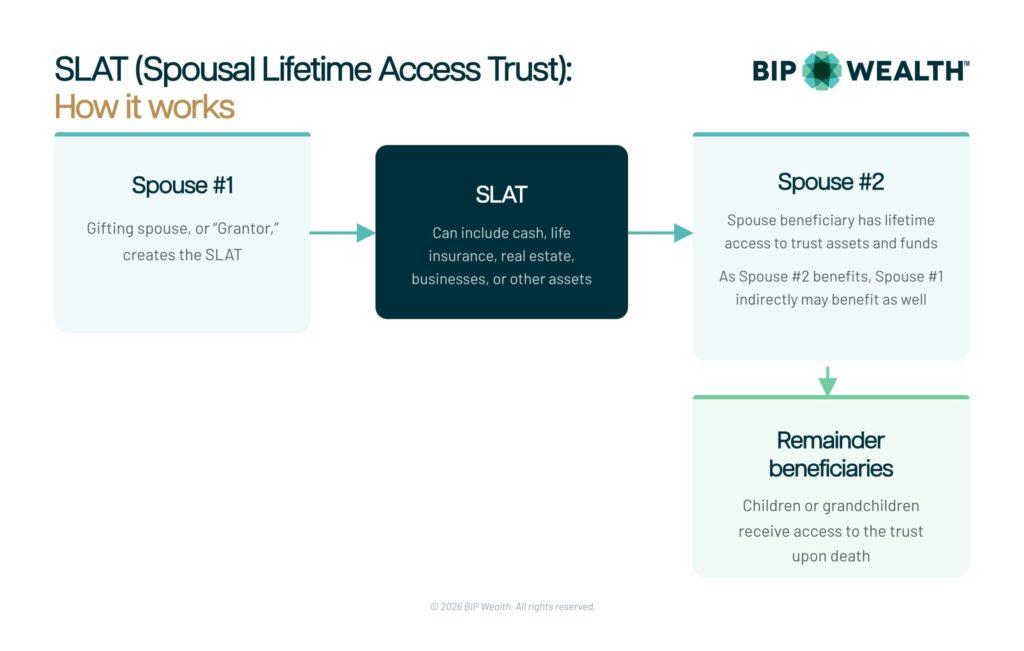
In practice, this allows a family to transfer wealth strategically while maintaining some flexibility if future cash flow needs arise.
SLATs easily become part of a holistic wealth management strategy that coordinates investment management, tax planning, estate planning, and long-term liquidity needs.
The structure itself is highly technical from both a legal and tax perspective, typically requiring estate attorneys, CPAs, and wealth advisors to assist with planning.
At a high level:
Assets commonly transferred include:
Because the assets are removed from the grantor’s taxable estate, future appreciation may also avoid estate taxes.
SLATs are often discussed with families whose estates may eventually exceed the $30M combined estate tax exemption available to a couple. In many cases, clients exploring SLATs have net worths exceeding $15 million and are beginning to ask bigger-picture questions like, “You said I may have an estate tax problem. What can we do about it?”
A SLAT is one option within that broader estate tax planning toolbox.
A SLAT is usually not an early-career planning strategy. More often, these conversations happen later in life—families in their 50s or older, business owners with appreciating assets, or couples who have been married for decades and already have foundational estate documents in place.
In many cases, the strategy is best suited for:
This is especially true for families already focused on protecting wealth for children and future generations through long-term family and individual planning.
While there are many benefits, there are some potential risks associated with SLATs. Here’s a look at them.
The primary benefit of an SLAT is that it reduces future estate tax exposure by removing appreciating assets from the taxable estate.
Although the grantor gives the assets away, the beneficiary spouse may still access trust distributions under the trust terms.
While not usually the primary objective, SLATs may also provide a layer of creditor protection depending on the trust structure and state law.
SLATs can help families move wealth efficiently to future generations while maintaining continuity in the overall financial plan.
If the beneficiary spouse is no longer part of the household, indirect access to those assets may effectively disappear, and it would be encouraged to work with a Certified Divorce Financial Analyst.
That said, many families pursuing SLATs are long-married couples with stable financial structures, reducing the likelihood of this outcome, so this concern is not very common.
An unexpected life event, such as premature death, can also fundamentally change the structure.
If the beneficiary spouse dies first, children often become the primary beneficiaries. That may create a scenario where adult children ultimately stand to benefit from control assets that may have once supported the surviving spouse’s lifestyle.
A SLAT is irrevocable. The grantor is permanently transferring ownership of those assets.
That means liquidity planning matters. If you gift $10 million into a trust, the assets remaining outside the trust still need to support your long-term lifestyle.
Couples sometimes create SLATs for each other, but if the trusts are too similar, the IRS may apply reciprocal trust rules that undermine the intended tax treatment.
This is one reason why drafting and customization are critically important.
Modern trust planning often includes multiple “levers” built into trust documents to preserve flexibility as laws, tax rules, and family dynamics evolve.
But even with that flexibility, a SLAT should never exist in isolation.
The strategy works best when coordinated with:
For families navigating substantial wealth, the goal should be to build a durable financial structure that can support multiple generations while adapting to life’s inevitable changes.
At BIP Wealth, your estate plans are integrated into a holistic plan centered around planning for unexpected life events, investment strategy, and long-term family goals. If you’re interested in an SLAT or want to discuss your portfolio strategy, connect with an advisor today.
BIP Wealth, LLC (“BIP Wealth”) offers investment advisory services and is registered with the U.S. Securities and Exchange Commission (“SEC”). Registration with the SEC as a registered investment adviser does not imply a certain level of skill or training. This blog is intended for informational purposes only and is intended solely for the addressee. For more information about BIP Wealth, please refer to our Form ADV, available at adviserinfo.sec.gov or upon request.
This blog is intended for informational purposes only and does not constitute tax or legal advice. Please consult your personal tax professional and estate planning attorney before making any tax or legal decisions.
Investors should seek tax and legal advice based on your particular circumstances from an independent tax professional and estate planning attorney as laws are subject to interpretation, legislative change, and are unique to each individual's particular set of facts and circumstances.
In the world of estate planning, where many concepts already feel slightly out of reach, Trusts can certainly challenge the mind. These structures fulfill various needs and goals and can be broken down into myriad categories. In this blog, we’ll answer common questions including: What is a trust? When do I need a trust? Does a trust save on taxes? Does a trust keep creditors away?
A trust is a legal structure in which a Trustee is designated to manage assets for the benefit of one or more Beneficiaries. The person who establishes and generally funds the trust is called the “Grantor” or “Settlor.”
Often, a trust is established to ensure assets are managed in a certain way and by a certain person or person(s).
There are many kinds of trusts that serve many different purposes.
One of the most common types of trusts is the Revocable Living Trust (“RLT”). In this type of trust, the Grantor, Trustee, and Beneficiary are usually the same person. The purpose of the trust is simply to remove the assets from the Grantor’s individual name to avoid Probate and to help ensure the smooth transition of assets in the event of incapacity or death. This type of trust is a great estate planning tool, but does not provide tax savings or creditor protection.
Alternatively, Irrevocable Trusts are often used for tax planning or asset protection purposes. These trusts can be established during life (an “Inter Vivos” or “Living” Trust) or upon death (a “Testamentary” Trust).
For example, during life one can establish and fund an Irrevocable Living Trust for the benefit of a spouse, children, and / or grandchildren, in order to move assets out of the taxable estate and ensure the assets are protected for generations to come. Or, in a Will you can establish a trust for the benefit of your spouse and children which protects those assets from future creditors and liability, including divorcing spouses, after you have passed. This would be an Irrevocable Testamentary Trust.
Trusts can have an impact on income taxes (imposed on earnings) as well as gift and estate taxes (imposed on the transfer of wealth).
As far as income taxes are concerned, income generated by trust assets is still taxable, either to the Grantor, to the trust itself, or to a beneficiary or beneficiaries. Often, it is preferable that the Grantor be liable for income taxes because the trust is subject to compressed income tax brackets. In other words, taxes may be lower if the Grantor is still alive and is responsible for them.
In the event of a testamentary trust, the Grantor is deceased, so the income is either taxed to the trust or, in the event of a distribution to a beneficiary, can be taxed to the beneficiary.
Concerning Gift and Estate Taxes, a transfer of assets to an Irrevocable Trust created for (and controlled by) someone other than the Grantor may be a taxable gift that has to be reported and counted against a person’s “lifetime exemption.” The trust assets may then be able to grow outside of the Grantor’s taxable estate, and the appreciation can pass estate tax free. The typical Revocable Living Trust, on the other hand, has no gift or estate tax impact at all.
Some trusts are creditor-protected and some are not. Generally speaking, a revocable trust (one that the Grantor can change/amend/revoke) is not protected from the Grantor’s creditors because of the Grantor’s unrestricted access to Trust assets.
In a majority of states, creditors can also reach Irrevocable Trust assets if the Grantor is also the Beneficiary. That is, if I set up an Irrevocable Trust for my own benefit, my creditors can still reach them. However, a minority of states will protect the assets of these “self-settled” Irrevocable Trusts when structured properly under the laws of those states.
Irrevocable Trusts established for the benefit of someone else (e.g. my spouse or my child) can be protected from creditors – both the Grantor’s creditors and those of the beneficiary(ies).
An experienced estate planning attorney can answer both of these questions for you. Your attorney should consider your goals and evaluate whether a trust (and which kind of trust) is necessary to accomplish those goals. Trusts are certainly not a one-size-fits-all solution and many factors should be weighed.
If a Trust of any kind is necessary or helpful, the attorney would draft the trust document in a manner that is tailored to your needs and assist in the execution of the necessary documentation. The final step is to provide guidance and help transferring assets to the trust, by way of retitling accounts and executing deeds to trust for real property.
A note from Sarah: Trust planning is deeply personal, and the right structure for you depends on factors specific to your life, your family, and your goals. If any of these questions resonate with you, I'd encourage you to reach out.
At BIP Wealth, our team of trusted advisors can help clients like you evaluate whether a trust is advisable or necessary and connect you with professionals to help you put a comprehensive trust plan in place.
A will is a legal document that expresses your wishes for how your assets should be distributed after you die, but it has to go through probate, which is a court-supervised process that takes time and can be costly. A trust, on the other hand, holds your assets during your lifetime and transfers them to your beneficiaries outside of probate entirely. That means a faster, more private transition for your family. For most clients, the desire to avoid probate is the primary reason we explore whether a trust makes sense for them.
Generally, yes, but only for assets that are actually titled in the name of the trust. This is a detail that catches a lot of people off guard. A Revocable Living Trust is specifically designed to keep your estate out of probate court, but if you never transfer your accounts or property into the trust, those assets will still go through probate. Part of the process of setting up a trust is what's called "funding" it, meaning retitling accounts and executing deeds so your assets are properly held by the trust.
It depends on the type of trust. A Revocable Living Trust does not provide creditor protection; because you can change or revoke it at any time, creditors can still reach those assets. An Irrevocable Trust, however, can offer meaningful protection, particularly when it's established for the benefit of someone other than yourself, like a spouse or children. If you're seeking creditor protection as a goal, that's an important conversation to have with an estate planning attorney, as the rules vary significantly by state.
A will alone may be sufficient for someone with a straightforward estate, few assets, and no concerns about probate, taxes, or creditor exposure. But for clients with more complex situations—a blended family, significant assets, a child with special needs, business interests, or multi-state real estate—a trust often becomes an essential part of the plan. There's no universal answer here, which is why I always encourage people to think through their specific goals before assuming one approach is right for them.
For a Revocable Living Trust, the trust becomes irrevocable at the grantor's death—meaning it can no longer be changed. At that point, the successor trustee steps in to manage and distribute the assets according to the trust's terms, without the need for probate court involvement. For an Irrevocable Trust, the structure and administration at death depends on how it was originally drafted. In either case, having a clear, well-drafted trust and a trustee who understands their responsibilities makes an enormous difference in how smoothly things go for your family.
Sarah Watchko is an employee of BIP Wealth and has been serving families' estate planning needs for nearly 20 years. This content is for informational purposes only and does not constitute legal, financial, or tax advice. Readers should consult with a qualified estate planning attorney before making any decisions related to estate planning.
A few months ago, a colleague mentioned that a friend of theirs was trying to figure out how to exit a sizable real estate portfolio. The timing was good—I had just wrapped up a comprehensive exit planning analysis for a long-time real estate investor, and the parallels were striking enough that I thought it was worth sharing.
My client is 62 years old and has spent decades building a portfolio of nearly 40 single-family residential rental homes. Over the years, he's become genuinely good at finding, renovating, and managing these properties. But he had reached the point in life where he was ready to put the toolbox down. He wanted out of the day-to-day grind. The question wasn't whether to exit, it was how.
Before looking at any specific strategies, we got clear on what a successful outcome actually looked like for him. His goals were straightforward:
That last point turned out to matter more than almost anything else.
We put three main exit paths under the microscope:
Deferred Sales Trust (DST structure).
Attractive because it allows you to defer capital gains at the point of sale and spread recognition of income over time. For investors with highly appreciated assets, this can look very appealing on paper.
1031 Exchange Real Estate Program.
A way to swap out of active management and into a passive institutional real estate structure while continuing to defer taxes. The appeal here was removing himself from the day-to-day without triggering an immediate tax bill.
Staged, tax-managed disposition, selling properties over time.
The more straightforward path: sell homes strategically over a 10-year window, recognize and pay long-term capital gains taxes as you go, and reinvest proceeds into income-producing assets better suited to retirement.
On the surface, the tax-deferral strategies looked compelling. Who wouldn't want to kick the tax bill down the road?! But when we fully modeled the economic impact, including fees, ongoing administrative costs, investment restrictions, liquidity constraints, and the compounding effect of those variables over time, the picture changed substantially.
For this particular client, the most advantageous path was not the most complex one. The staged, taxable sell-down produced the strongest projected outcome for long-term family net worth by approximately $2 million.
The reason comes down to something that often gets underestimated in these conversations: fees compound too, and they compound against you. When you layer in program fees, administrative costs, and the loss of control over how and where your proceeds are reinvested, you can give back a significant portion of the tax savings you thought you were locking in.
By paying taxes along the way—and keeping control of the capital—my client retained more money working for him over the long run. And the math bore that out.
Beyond the numbers, there was something else the staged approach offered that the tax-deferral structures couldn't: flexibility.
Rather than committing the entire portfolio to a single transaction or investment vehicle all at once, my client could sell homes selectively based on market conditions, tenant turnover, maintenance costs, and his own cash flow needs in any given year. When properties sold, proceeds could flow into investment approaches better aligned with where he is in life: lower complexity, more passive income, less operational burden.
That kind of control has real value. It's difficult to quantify, but it's real.
There's no universal "best" exit strategy for owners of multiple investment properties. Deferred Sales Trusts, 1031 exchanges, institutional real estate funds, installment sales, and staged taxable dispositions can all make sense depending on the circumstances.
The variables that matter most include:
For a younger investor who plans to keep accumulating properties, tax deferral strategies may offer compelling long-term advantages. But for an investor approaching retirement—someone who wants less complexity, not more, and who values flexibility above all—a thoughtfully managed taxable exit strategy may ultimately put more money in the family's pocket.
My client got what he came in wanting: a clear path to reduce the operational demands of managing nearly 40 homes, a way to keep the income coming in, and a projected increase in long-term family wealth, all without locking himself into a structure that would limit his options for years to come.
This analysis serves as a strong reminder that sophisticated planning is not always about eliminating taxes at all costs. Often, it is about balancing taxes, fees, control, flexibility, and quality of life to achieve the best overall financial outcome for the client and family.
That's what we did here, and for this client, the answer was simpler than expected.
Common exit strategies include Deferred Sales Trusts (DSTs), 1031 exchange programs, installment sales, and staged taxable dispositions. The best strategy depends heavily on the investor's age, income needs, estate planning goals, and tolerance for complexity and fees.
A DST can be useful for deferring capital gains, but investors should carefully model the full cost including program fees, investment restrictions, and reduced flexibility, all before assuming it's the most advantageous path. In some cases, a staged taxable sale produces a better long-term outcome.
Options include 1031 exchanges, Deferred Sales Trusts, and installment sales. However, a staged sell-down over multiple years while paying long-term capital gains rates can also be highly effective when factoring in the costs and constraints of tax-deferral structures.
It depends on your goals. For investors who want to stay in real estate and continue deferring taxes, a 1031 exchange may be advantageous. For those approaching retirement who want simplicity, flexibility, and control over their capital, a strategic sell-down may produce better overall results after accounting for fees and investment restrictions.
There's no single right answer, but investors in their late 50s and early 60s—particularly those managing a large number of properties—benefit from beginning exit planning well in advance. Earlier planning creates more options and allows for a multi-year strategy that spreads tax recognition and maximizes flexibility.
The information presented in this article is for educational purposes only and does not constitute investment, tax, or legal advice. Every investor's situation is different, and strategies that are appropriate for one client may not be appropriate for another. Past results from any planning strategy are not a guarantee of future outcomes. Please consult with a qualified financial advisor, tax professional, and attorney before making decisions about your real estate portfolio or exit strategy.
BIP Wealth, LLC is a registered investment adviser. Registration does not imply a certain level of skill or training.
Signed into law on July 4, 2025, the One Big Beautiful Bill Act, OB3 for short, offers comprehensive tax reform that will take effect on January 1, 2026. To help BIP Wealth clients better understand the new laws, our in-house Estate Planning Attorney, Sarah Watchko, and Tax Advisor, CPA, Allie Powell, teamed up to present a recent webinar. In this recap, we’ll review the key points of their presentation, breaking down what changed and what remained unchanged in our tax laws.
The webinar started with an iconic quote from Benjamin Franklin: “Our new Constitution is now established and has an appearance that promises permanency; but in this world nothing can be said to be certain except death and taxes.” Simply put, while these new tax laws come with changes for now, reforms in the future are to be expected, as tax laws are inherently political. So, what do you need to know about the One Big Beautiful Bill Act? In this blog, we’ll break it down for you.
While we could analyze the entire bill word-for-word, we decided to break our webinar into two main categories: Gift & Estate Taxes and Personal Income Taxes. In each section, we discussed what changed vs. what remained the same, compared to the significant reforms passed in the 2017 Tax Cuts & Jobs Reforms Act.
To start, let’s break down what remained the same. Overall, most of the laws surrounding gift & estate taxes remained the same on the federal level. While specific states may have their own estate taxes, portability, annual exclusions, and the basic framework of the 2017 reforms have all been left untouched.
The one big change comes with transfer tax exemptions. Now permanently set at $15 million ($30 million for a married couple), this allows you to transfer assets to a loved one without any taxes being imposed on your estate. For example, if you have $1 billion in assets and gift it all to your spouse during your life, this will not go towards the exemption amount. Plus, with portability remaining unchanged, if the $1 billion is left to your spouse, they can take the $15 million in exemptions with them, thus giving you the $30 million.
Another key tax law that remains unchanged is the annual exclusion. Another way to think about this concept is that the IRS doesn’t want to keep tabs on all of your birthday presents. As of the 2025 fiscal year, any gifts up to $19,000 can go tax-free. And there are no limits on the amount of gifts you can give up to the $15 million exemption.
The chart below tracks how the total exemption amount has increased over time, from just $675,000 per person in 2001.
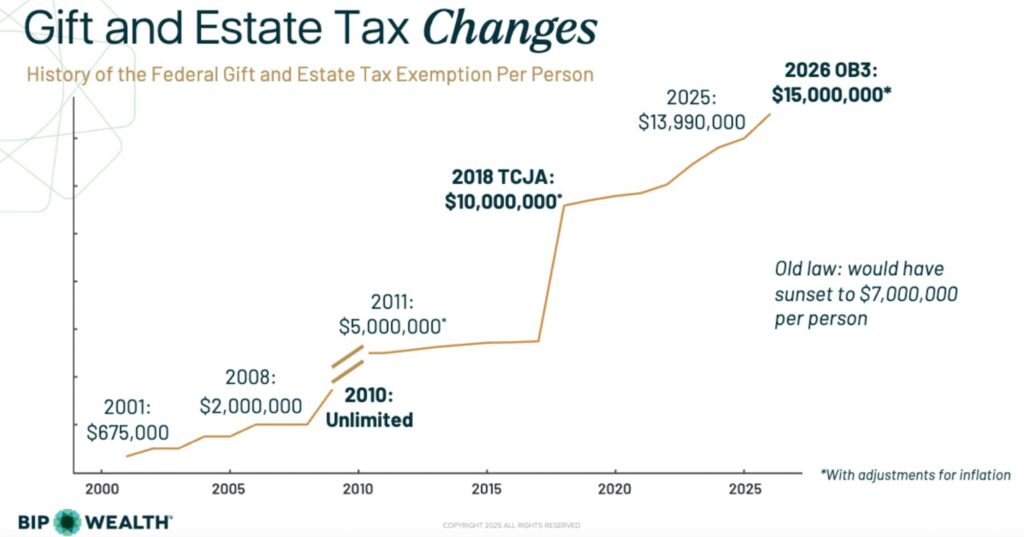
The impacts of these changes are clear. If your estate is worth under $7 million, or $14 million as a married couple, your estate planning strategies should remain largely unchanged. If your estate is worth between $7 million and $15 million ($14 million and $30 million as a married couple), you are now safer from estate taxes than ever before. If your estate is worth more than $30 million, your strategy would remain largely unchanged. As always, it’s important to regularly consult your tax advisor to ensure your plan continues to adapt to changing financial regulations.
Where the new laws bring a plethora of changes is with personal income tax. Now, this bill was pushed through by Congress. Now, it is up to the IRS to implement each change. OB3 continues a lot of the shifts made in 2017, which at the time was the most significant tax reform since 1986. To set the record straight, Social Security benefits will remain taxable. There were rumors in the media that this was going away, but up to 85% of your future benefits will still be included in your taxable income. That remains unchanged.
The income tax brackets from 2017 also remain the same, giving working families a bit more security in knowing they’ll likely not be paying more in 2026 and the years to come.

Additionally, the standard deduction for taxes remains much higher, with up to $15,000 for individuals and $30,000 for married-joint filings. This can be used for medical expenses, property taxes, charitable contributions, and more.
Now, what will be changing? The short answer is quite a bit. The State and Local Tax Cap (SALT) for individuals has increased from $10,000 to $40,000. While this law phases out higher earners of $500,000 or more, it will allow you to potentially enjoy higher itemized deductions until 2030. On top of this, Trump Accounts will now be opened for kids born from 2025-2028. The federal government will make an initial $1,000 deposit, with up to $5,000 in annual after-tax contributions until the child reaches 18 years of age. Growth is tax-deferred, with early withdrawals after age 18 subject to a 10% penalty. However, many questions remain about how these accounts will work, what will be sunset in the future, and the overall mechanics, so be sure to discuss this with your tax advisor.
Additional changes include a $6,000 deduction for taxpayers 65 years and older, expansions to eligible expenses for 529 funds, and no taxes on overtime and tips up to $25,000. For business owners, the bill also allows for an alignment of tax-deductible expenses with cash flow, plus the potential for significant capital gains savings through company stock.
If you have any questions about the new OB3 laws or need to take a closer look at your current estate plan, contact the BIP Wealth team today!
Disclaimer: This is a very high-level overview of some of the important aspects of the new tax law. It's intended for general informational purposes, and it's not intended to constitute tax, legal or investment advice, so if you need or want tax, legal or investment advice, please consult your personal tax professional or estate planning attorney before making any decisions.
January is the perfect time to start fresh and plan ahead for 2025. From ongoing changes in the market to the recent U.S. Presidential Election, there is a lot for both individuals and business owners to consider when reviewing their financial plans. From refining your investment strategies to ensuring your estate plan is up to date, a comprehensive new year financial checklist and review can uncover opportunities to strengthen your financial foundation. In this blog, we’ll discuss steps you can take to protect your wealth in the new year.
Because your goals act as the foundation for your wealth plan, the new year financial planning checklist is the perfect time to determine if anything needs changing.
Ask yourself a few of these questions: Are you on track to achieve your short- and long-term objectives? Do you need to adjust savings targets, diversify your investments, or reprioritize your spending? Reassessing your goals annually ensures you remain focused, intentional, and adaptable as you navigate the markets.

Although estate planning may seem like it’s only beneficial for those with significant net worths, we’d argue that it is important for everyone to regularly review (or establish). Life changes—such as marriages, divorces, births, or deaths—can impact your wishes, while shifting tax laws may create new opportunities or challenges. While going through your new year financial planning checklist, it may be in your best interest to revisit your estate plan to ensure it reflects your current circumstances and goals.
At BIP Wealth, we consider a wide range of factors when helping our clients plan their estate—from their unique financial goals to Power of Attorney and Healthcare Directives. Together, we’ll assist with your annual review to make sure you minimize your tax bill and help create generational wealth for your family.
While investing is a long-term way to build wealth, it is important to review your portfolio with your wealth manager when going through your new year financial planning checklist. Maintaining the right mix of investments such as small vs. large-cap investments, exchange traded funds (ETFs) vs mutual funds, and private vs. public investments, can help ensure you have a diversified portfolio to weather market fluctuations. During your new year financial planning, you can ensure your investments properly match your financial goals and are risk-tolerant. Rebalancing your portfolio can help restore the intended balance between stocks, bonds, and other asset classes, allowing you to manage risk effectively.

One of the best ways to build long-term wealth is through tax-advantaged accounts, such as 401(k) plans. These accounts enable your money to grow over time without the burden of hefty annual tax bills. In fact, regulatory changes in 2024 allowed investors to commit more money than ever to their plans, ensuring more wealth grows tax-advantaged.
For families, don’t overlook the power of Health Savings Accounts (HSAs), too. These accounts provide a triple tax benefit: contributions are tax-deductible, earnings grow tax-free, and withdrawals for qualified expenses are tax-free.
If you have children who are planning on going to college, 529 plans are another great option to consider when going through your new year financial planning checklist. By utilizing accounts like these, you can fortify your wealth for the long term.

If you’re a business owner who offers or is looking to offer 401(k) benefits to your employees, it is not a set-and-forget type of strategy. One of the most important small business new year checklist steps is to benchmark your 401(k) plan. Why is this important? This can help you evaluate the costs of your plan and potentially find ways to reduce your tax bill. During the benchmarking process, your financial advisor will help you identify new investment opportunities to meet both your goals and the goals of your employees.

Finally, consider whether you’d like to set money aside for charitable contributions when going through your year-end financial checklist, as they can offer more tax benefits in the new year. You can also take advantage of the annual gift tax exclusion, which allows you to gift up to $18,000 (for 2024) per recipient without incurring gift taxes. If you’re married, you can double this amount by gifting jointly. This is an excellent way to transfer wealth to the next generation while minimizing taxes.
If you’re looking for holistic wealth management services like you read about above, be sure to reach out to our team. You can also check out our resources hub to learn more about the latest topics in the financial world.
It is important to establish a new year financial planning checklist that helps you identify financial planning opportunities, new investment ideas, and ways to minimize taxes. This can help you grow your wealth over time while losing as little to tax bills as possible.
A new year financial planning checklist can help you ensure your goals are being met and that your financial plan is sound.
Yes! For individuals, families, and business owners, consulting a financial advisor here at BIP Wealth can be a great way to simplify the process. Think of our team as your Personal CFO.
