

A Spousal Lifetime Access Trust (SLAT) is an estate planning strategy often used by high-net-worth families to move appreciating assets out of a taxable estate while still allowing a spouse to benefit from those assets during their lifetime. SLATs can offer estate tax mitigation, gifting flexibility, and asset protection benefits, but they also come with important risks tied to divorce, premature death, liquidity planning, and complex trust structuring.
What Is A Spousal Lifetime Access Trust?
For families with significant wealth, estate planning eventually becomes about more than basic wills and powers of attorney. Once a household approaches estate tax exposure, advanced strategies often enter the conversation, and one of the more common tools is the Spousal Lifetime Access Trust.
A Spousal Lifetime Access Trust (SLAT) is an irrevocable trust created by one spouse for the benefit of the other spouse, typically alongside children or future generations. The primary goal is to move assets outside of the taxable estate while still preserving a degree of indirect household access to those assets.
Check out this Spousal Lifetime Access Trust diagram for a helpful visual:
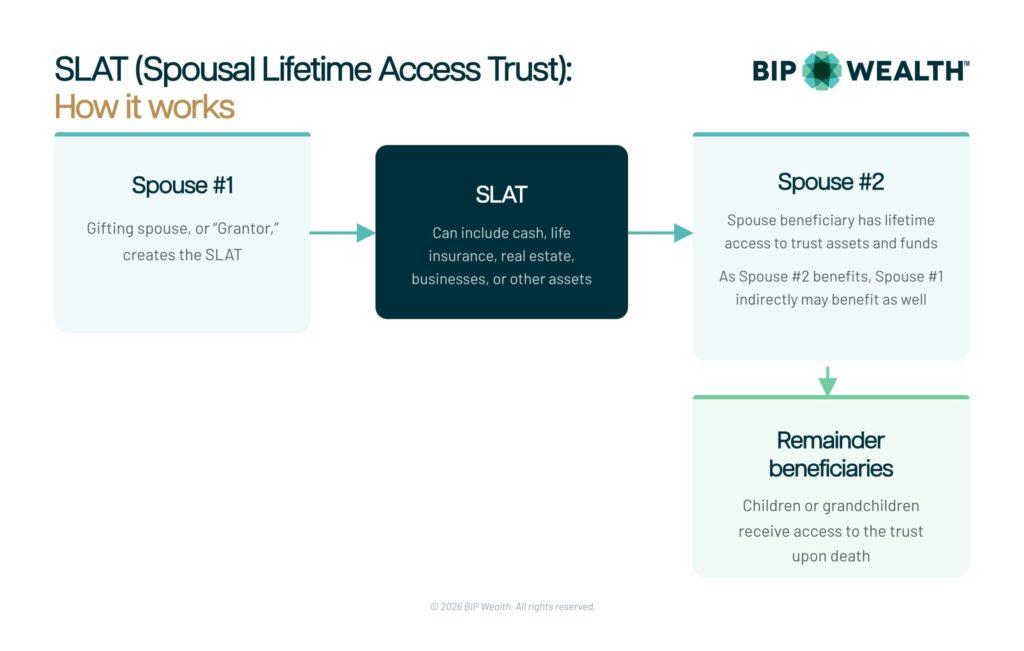
In practice, this allows a family to transfer wealth strategically while maintaining some flexibility if future cash flow needs arise.
SLATs easily become part of a holistic wealth management strategy that coordinates investment management, tax planning, estate planning, and long-term liquidity needs.
How Does A Spousal Lifetime Access Trust Work?
The structure itself is highly technical from both a legal and tax perspective, typically requiring estate attorneys, CPAs, and wealth advisors to assist with planning.
At a high level:
- One spouse creates the trust
- Assets are gifted into the trust
- The beneficiary spouse can receive distributions
- Children or future heirs are often remainder beneficiaries
Assets commonly transferred include:
- Investment portfolios
- Closely held business interests
- Real estate
- Private investments
- Concentrated stock positions
Because the assets are removed from the grantor’s taxable estate, future appreciation may also avoid estate taxes.
SLATs are often discussed with families whose estates may eventually exceed the $30M combined estate tax exemption available to a couple. In many cases, clients exploring SLATs have net worths exceeding $15 million and are beginning to ask bigger-picture questions like, “You said I may have an estate tax problem. What can we do about it?”
A SLAT is one option within that broader estate tax planning toolbox.
Who Is This Strategy Typically Designed For?
A SLAT is usually not an early-career planning strategy. More often, these conversations happen later in life—families in their 50s or older, business owners with appreciating assets, or couples who have been married for decades and already have foundational estate documents in place.
In many cases, the strategy is best suited for:
- High-net-worth families
- Business owners
- Couples focused on multigenerational wealth
- Investors with large taxable estates
- Families interested in lifetime gifting strategies
This is especially true for families already focused on protecting wealth for children and future generations through long-term family and individual planning.
Spousal Lifetime Access Trust Pros And Cons
While there are many benefits, there are some potential risks associated with SLATs. Here’s a look at them.
Potential Benefits
Estate Tax Mitigation
The primary benefit of an SLAT is that it reduces future estate tax exposure by removing appreciating assets from the taxable estate.
Flexibility For The Household
Although the grantor gives the assets away, the beneficiary spouse may still access trust distributions under the trust terms.
Asset Protection
While not usually the primary objective, SLATs may also provide a layer of creditor protection depending on the trust structure and state law.
Long-Term Wealth Transfer
SLATs can help families move wealth efficiently to future generations while maintaining continuity in the overall financial plan.
Potential Risks
Divorce
If the beneficiary spouse is no longer part of the household, indirect access to those assets may effectively disappear, and it would be encouraged to work with a Certified Divorce Financial Analyst.
That said, many families pursuing SLATs are long-married couples with stable financial structures, reducing the likelihood of this outcome, so this concern is not very common.
Premature Death
An unexpected life event, such as premature death, can also fundamentally change the structure.
If the beneficiary spouse dies first, children often become the primary beneficiaries. That may create a scenario where adult children ultimately stand to benefit from control assets that may have once supported the surviving spouse’s lifestyle.
Loss Of Direct Ownership
A SLAT is irrevocable. The grantor is permanently transferring ownership of those assets.
That means liquidity planning matters. If you gift $10 million into a trust, the assets remaining outside the trust still need to support your long-term lifestyle.
Reciprocal Trust Rules
Couples sometimes create SLATs for each other, but if the trusts are too similar, the IRS may apply reciprocal trust rules that undermine the intended tax treatment.
This is one reason why drafting and customization are critically important.
How a Spousal Lifetime Access Trust Fits Into Your Holistic Plan
Modern trust planning often includes multiple “levers” built into trust documents to preserve flexibility as laws, tax rules, and family dynamics evolve.
But even with that flexibility, a SLAT should never exist in isolation.
The strategy works best when coordinated with:
- Estate planning documents
- Investment strategy
- Tax planning
- Liquidity forecasting
- Insurance analysis
- Planning for unexpected life events
For families navigating substantial wealth, the goal should be to build a durable financial structure that can support multiple generations while adapting to life’s inevitable changes.
At BIP Wealth, your estate plans are integrated into a holistic plan centered around planning for unexpected life events, investment strategy, and long-term family goals. If you’re interested in an SLAT or want to discuss your portfolio strategy, connect with an advisor today.
BIP Wealth, LLC (“BIP Wealth”) offers investment advisory services and is registered with the U.S. Securities and Exchange Commission (“SEC”). Registration with the SEC as a registered investment adviser does not imply a certain level of skill or training. This blog is intended for informational purposes only and is intended solely for the addressee. For more information about BIP Wealth, please refer to our Form ADV, available at adviserinfo.sec.gov or upon request.
This blog is intended for informational purposes only and does not constitute tax or legal advice. Please consult your personal tax professional and estate planning attorney before making any tax or legal decisions.
Investors should seek tax and legal advice based on your particular circumstances from an independent tax professional and estate planning attorney as laws are subject to interpretation, legislative change, and are unique to each individual's particular set of facts and circumstances.
