How to align your generosity with a tax-efficient financial planning strategy
Charitable giving is one of the most personal decisions in a financial plan. The organizations you support and the causes you believe in reflect who you are. Giving is also a financial planning tool, and when done strategically, it can create meaningful tax efficiencies that allow you to give more over time without a corresponding increase in cost to you.
Whether you are just beginning to think about how to incorporate philanthropy into your financial life, looking to give more effectively in retirement, or curious about vehicles like donor-advised funds, this post covers the basics: where to start, how different strategies actually work, and where your financial advisor fits into the picture.
The first question is not which strategy to use, it’s to determine what you actually care about and want to support with your hard-earned dollars. Before any structure or tax planning enters the conversation, it’s worth taking inventory of the organizations and causes that matter most to you, and being honest about the level of ongoing engagement you want.
Some clients want to give regularly to a short list of organizations they know well. Others want flexibility to respond to needs as they arise, or to involve children or grandchildren in a family giving tradition. Others give substantially in a single high-income year and then distribute that giving over time. The right approach depends on your personal situation.
Once you know where you want to give, it pays to do a small amount of due diligence. The most important factor is transparency. A well-run organization will clearly communicate how donations are used, what percentage goes to programs versus administrative costs, and how it measures its own impact.
A few things worth checking before you give:
The last point tends to be the most telling. A willingness to be honest about limitations and setbacks is frequently a better indicator of organizational integrity than polished public-facing materials.
Once you are clear on where you want to give, the question becomes how. The method you use can significantly affect both the tax impact on you and the amount the organization ultimately receives.
The most straightforward approach, cash donations to qualifying 501(c)(3) organizations are generally deductible up to 60 percent of your adjusted gross income (AGI) in a given year. For many donors, this is perfectly sufficient, though it is not always the most efficient path.
If you hold stock or other appreciated assets that have grown significantly in value, donating those assets directly to a charity rather than selling them first can be a more effective strategy than giving cash.
Here’s why: when you sell an appreciated asset, you may owe capital gains tax on the difference between what you paid and what it is worth today. But when you donate the asset directly, you avoid that tax event entirely. You receive a deduction for the full fair market value of the asset, and the charity receives the full value as well. Both sides benefit from the gain you would otherwise have shared with the IRS.
The same logic applies to real estate and other non-cash assets, though these involve additional complexity: appraisals, timing considerations, and in some cases coordination with estate planning. If you are considering a non-cash gift of any significance, your advisor and tax professional should both be in the conversation.
A donor-advised fund (DAF) is one of the most flexible and tax-efficient giving vehicles available to individual donors. Think of it as a charitable investment account: you contribute assets to the fund, receive an immediate tax deduction, and then recommend grants to your chosen charities over time.
The separation between the contribution and the actual distribution is the key advantage. In a year when your income is unusually high, such as a business sale, a large bonus, or a Roth conversion, you can fund a DAF substantially and capture the full deduction in that year, then distribute to charities over the following months or years on your own timeline.
Assets in the DAF can also be invested and grow tax-free while you decide how and when to distribute them. Over a multi-year giving horizon, that growth can meaningfully increase the total dollars available for charity.
One important note: Contributions to a DAF are irrevocable. Once assets are in the fund, they must eventually go to charitable organizations and cannot be returned to you. For donors who are deliberate about their giving, this is generally not a concern, but it is worth understanding before funding one.
If your charitable giving typically falls below the standard deduction threshold, you may not be capturing the greatest tax benefit from your contributions, especially if your contributions exceed $1,000 ($2,000 married filing jointly). A strategy called "bunching" addresses this: instead of giving a moderate amount each year, you contribute two or three years' worth of giving in a single year, itemize that year, and take the standard deduction in the years in between.
A donor-advised fund pairs particularly well with this approach. You can bunch contributions into a DAF in a single tax year, receive the deduction, and then continue distributing to your preferred organizations on your normal schedule.
For clients who are 70½ or older and hold assets in a traditional IRA, the qualified charitable distribution (QCD) is one of the most tax-efficient giving tools available, and one of the most underutilized.
A QCD allows an individual to transfer up to $110,000 per year in 2026 (indexed for inflation) directly from your IRA to a qualifying charity. The distribution counts toward your required minimum distribution (RMD) but is excluded from your taxable income entirely. It does not appear on your tax return as income, which means it does not increase your AGI, may not affect Social Security taxation thresholds, and may not push you into a higher Medicare premium bracket.
For a donor who would be giving anyway, the QCD effectively converts an otherwise taxable RMD into a charitable gift at no additional cost. The charity receives the same amount it would have otherwise. You just get there with less tax friction.
One common misconception: you cannot contribute to a DAF using a QCD. The distribution must go directly to an operating public charity. This distinction matters when you are coordinating your broader giving plan.
Financial giving is one dimension of charitable engagement, but it is not the only meaningful one. Time, expertise, and professional networks can be just as valuable to the organizations you care about, and in some cases more so.
At BIP Wealth, this shows up in a number of ways. Our summer intern cohort participates in an annual service day as part of their program. Several members of our team coach sports in their communities. We sponsor local athletic organizations including the Alpharetta Ambush and the North Georgia Cycling Association, because we believe that investing in the places where people live and compete is part of what it means to be a good financial partner.
That belief extends to how we think about giving more broadly. Liz Patterson, a Relationship Manager at BIP Wealth, went on a mission trip to Zimbabwe and came back with a perspective that shapes how she talks with clients about charitable engagement.
"Going on my first mission trip to Zimbabwe brought to life the idea that giving to a cause I care about means more than just giving dollars," she shared. "The entire experience changed how I think about giving in a way that reading about a cause never quite does. Seeing the work firsthand and meeting the people doing it has a way of clarifying both where your dollars are most useful and where your time and presence might matter even more."
When you are thinking about where to direct your energy alongside your dollars, the two do not have to be independent decisions. Some of our clients find that getting closer to an organization by attending events, volunteering, or serving on a committee deepens their giving in ways they did not expect.
Charitable giving sits at the intersection of your values, your tax situation, and your long-term financial plan. That is precisely where a good financial advisor should be most useful.
We approach charitable giving as an integrated component of your financial plan rather than an afterthought. That means coordinating with your tax professional on timing and strategy, helping you evaluate vehicles like DAFs or QCDs in the context of your income and portfolio, and making sure your giving aligns with your broader estate and legacy goals.
If you are giving without a strategy, or if charitable giving has not yet come up in conversations with your financial advisor, that’s worth mentioning. This is a hallmark of who we are at BIP, so reach out to start a conversation today.
This commentary is provided for general informational purposes only and does not constitute investment, legal, or tax advice. Tax rules and contribution limits referenced are as of a specific date and are subject to change. Charitable deductibility depends on individual circumstances. Consult a qualified tax professional before making charitable giving decisions. BIP Wealth, LLC is a registered investment adviser registered with the SEC. Registration does not imply a certain level of skill or training.
If you live in Georgia, there's some genuinely good news coming out of the state capitol.
Governor Brian Kemp recently signed two new tax bills into law: House Bill 463, the Georgia Economic Growth and Tax Relief Act of 2026, and Senate Bill 33, the Homeownership Opportunity and Market Equalization Act of 2026. Together, these laws represent meaningful tax relief for Georgia residents—and depending on your situation, they may have a real impact on what you owe at the state level.
At the signing, Governor Brian Kemp shared, "That approach has allowed us to return billions of dollars to taxpayers, and the legislation I signed today will keep that momentum going as we further lower our state income tax rate, deliver on meaningful property tax relief, and ensure job creators have the opportunity to grow and thrive in the Peach State."
Let me break these bills down for you.
Georgia's flat income tax rate is dropping from 5.19% to 4.99%, effective January 1, 2026. And that may not be the final stop. The law allows for additional annual reductions of 0.125%, potentially bringing the rate as low as 3.99% over time, contingent on the state's economic conditions.
For context: there had been speculation that Georgia might eliminate its state income tax altogether. That didn't happen—but a rate heading toward 3.99% is still a meaningful shift.
Larger standard deductions
The standard deduction is also getting a bump:
If you typically take the standard deduction on your Georgia return, this change may reduce your taxable income right away.
Higher dependent deductions
The deduction per dependent rises from $4,000 to $5,000, with a path to eventually reach $6,000. For families with multiple dependents, that additional relief may add up.
Expanded retirement income exclusion for those 65 and older
Starting in tax year 2027, taxpayers aged 65 and older may be able to exclude up to $70,000 of retirement income from Georgia state taxes, up from the current $65,000. If retirement income planning is on your radar, this may be worth factoring into your projections.
A temporary break on overtime and tips
For tax years 2026 through 2028, Georgia is temporarily allowing an exemption of up to $1,750 of overtime pay and cash tips from state income tax. It's a modest provision, but one worth knowing about if either applies to you.
Georgia property taxes have been rising, and this bill is designed to address that.
SB 33 creates a new mechanism called the Local Homestead Option Sales Tax (LHOST). Beginning in 2028, counties and municipalities may place this measure on local ballots. If voters approve it, the resulting sales tax revenue can only be used to offset property taxes for qualifying homeowners — it can't be redirected elsewhere.
The legislation also makes Georgia's existing base-year homestead exemption mandatory statewide, which had previously been optional at the local level.
Whether LHOST ends up on your county's ballot—and whether it passes—will depend on where you live and how local governments choose to act. But the framework is now in place.
Taken together, these two laws reflect a sustained commitment to reducing the tax burden in Georgia. If you're a Georgia resident, you may see:
Of course, how any of these changes actually affect your tax situation depends on your specific circumstances including your income, filing status, age, and where in Georgia you live. A conversation with your financial advisor can help you understand what may apply to you. Reach out to talk to one of our Personal Wealth Advisors today if you have specific questions about your situation.
This post is intended for informational purposes only and should not be construed as tax or investment advice. Tax laws are complex and subject to change; individual situations vary. BIP Wealth, LLC is a registered investment advisor. Registration does not imply a certain level of skill or training.
Trump Accounts are a new type of tax-advantaged savings account for children under 18 with a valid Social Security number, created under the One Big Beautiful Bill (OB3) signed into law on July 4, 2025 with accounts available on July 4, 2026. Children born between January 1, 2025, and December 31, 2028, receive a one-time $1,000 federal seed deposit from the U.S. Treasury. Families and employers can contribute up to $5,000 annually. Accounts must be invested in U.S. stock index funds, and when a child turns 18, the account automatically converts to a traditional IRA with standard withdrawal options.
A new federally backed savings account has arrived for American families, and if you have young children, it's worth understanding.
Trump Accounts, established under the One Big Beautiful Bill (OB3) and signed into law on July 4, 2025, are designed to give children a financial head start from birth. With a $1,000 government seed contribution, annual contribution limits, and a clear path to a traditional IRA at adulthood, these accounts introduce a new variable into family financial planning.
We’ve broken down what Trump Accounts are, how they work, and how they stack up against the 529 plan many families already leverage.
A Trump Account is a new type of individual retirement account (IRA) created specifically for children under the age of 18 who have a valid Social Security number. There are no income restrictions to open one, making these accounts accessible to a wide range of families.
The accounts were established under Section 530A of the Internal Revenue Code as part of the OB3 Act of 2025. Their primary purpose is to encourage long-term wealth-building from early childhood, with funds invested in U.S. stock index funds throughout the child's minor years.
One important note: an existing IRA cannot be converted into a Trump Account. The account must be established fresh and titled specifically as a Trump Account by a financial institution.
For children born between January 1, 2025, and December 31, 2028, the U.S. Treasury will deposit a one-time $1,000 pilot program contribution directly into the child's Trump Account. This money is not paid directly to the family. Instead, it is treated as a tax overpayment refunded into the account and is protected from certain offsets.
Children born before 2025 and under the age of 18 are still eligible to open a Trump Account but will not receive the $1,000 government deposit.
Beyond the government seed money, families, individuals, and employers can all contribute.
Here's how the limits break down:
The employer contribution is particularly valuable because it is not counted as taxable income for the employee. If your employer offers it, you should take it! That’s free money compounding on your child's behalf.
During the growth period, while the child is a minor, funds held in a Trump Account must be invested in eligible U.S. stock index funds, such as those tracking the S&P 500.
This is not a flexible brokerage account; investment options are limited by law during this phase.
Taxes around Trump Accounts are important to keep in mind. Check out these rules to keep your finances in order.
Contributions made by parents, guardians, or other individuals are made with after-tax dollars and are not tax-deductible. That means they do not reduce your taxable income in the year you contribute.
However, because these contributions are made with money you've already paid tax on, they create what's called tax basis in the account.
When the child eventually withdraws those contributed amounts, that portion comes out tax-free. The earnings on those contributions, however, are subject to income tax and, depending on when and how funds are taken out, potentially an early withdrawal penalty.
Employer contributions function differently because they are not taxable to the employee when made. When withdrawn later, employer contributions and their earnings are subject to standard income tax, similar to a traditional pre-tax retirement account.
While the child is a minor (ages 0-18), distributions from a Trump Account are generally not allowed, with limited exceptions for qualified rollovers, excess contributions, and death of the account beneficiary. This is an important distinction from other savings vehicles, such as 529 plans, which allow more flexible access to qualified education expenses during childhood.
On December 31st of the year before the child turns 18, the Trump Account officially converts to a traditional IRA. At that point, standard IRA rules apply, including the 10% early withdrawal penalty for distributions, unless an exception applies.
Some exceptions to the 10% early withdrawal penalty include the following, but note that ordinary income tax still applies to these distributions:
This means a child who saves consistently in a Trump Account from birth through age 18 could use those funds toward college, a first home, or eventually retirement—all with favorable tax treatment on the contributed portion. One of the Trump Account's unique benefits is that although it follows traditional IRA rules and provides tax-deferred growth, contributions made during the growth period (ages 0–18) are tax-free upon withdrawal. For more on how Roth and traditional IRA strategies fit into your family's broader plan, read our guide to the Roth IRA.
If you make after-tax contributions to a Trump Account, be sure to work with a CPA and track those contributions carefully using IRS Form 8606. This form establishes your tax basis and ensures that contributed amounts are not taxed again upon withdrawal.
For many families, the natural question is: how does a Trump Account compare to a 529 plan, and should I use one instead of the other?
The short answer is that they serve different purposes and can work well together. Here’s a breakdown of each.
A 529 is a tax-advantaged savings account designed primarily for education costs. Contributions are made with after-tax dollars, and the account grows tax-deferred. Withdrawals are tax-free when used for qualified education expenses.
Key features include:
Trump Accounts are better understood as a long-term wealth-building tool that begins in childhood. They are not designed primarily for education, and access before adulthood is limited.
Key features include:
If your primary goal is saving for education costs, a 529 plan remains a strong and flexible choice, particularly given the Roth IRA rollover option for unused funds and its broader investment menu.
If your goal is long-term wealth-building, a Trump Account offers a compelling head start, especially when the $1,000 federal seed and employer contributions are factored in.
For many families, especially those with children born between 2025 and 2028, the right answer may be both.
Before opening a Trump Account or adjusting your savings strategy, a few practical items are worth keeping in mind:
Our team works with families and individuals to build plans that account for education savings, retirement readiness, and generational wealth.
Trump Accounts represent a genuinely new option in the family financial planning toolkit. The combination of a federal seed contribution, employer contribution benefits, and a clear long-term wealth-building structure makes them worth understanding, even if the regulations are still taking shape.
The most important decision is simply to start. Whether through a Trump Account, a 529, or both, building the habit of saving early on your child's behalf is the highest-impact move available to you right now.
If you're not sure where Trump Accounts fit into your overall financial plan, a conversation with an advisor can help clarify the tradeoffs. The BIP Wealth team is here to help you make the right decision. Contact us today to learn more about how these accounts could work for your family.
Trump Accounts are a new type of individual retirement account for children under 18 with a valid Social Security number, established under the One Big Beautiful Bill Act signed into law on July 4, 2025. They are designed to help families build long-term wealth, with a one-time $1,000 federal deposit for qualifying children born between 2025 and 2028, annual contributions of up to $5,000, and mandatory investment in U.S. stock index funds. At age 18, the account converts to a traditional IRA.
Parents or guardians can open a Trump Account by filing IRS Form 4547 along with their federal tax return. An online application tool is expected to go live at trumpaccounts.gov. A financial institution will receive the funds and activate the account. Only one Trump Account can be established per child, and it must be titled specifically as a Trump Account. Existing IRAs cannot be converted.
Accounts can be opened in 2026 by filing IRS Form 4547 with your 2025 tax return. Contributions from individuals and families cannot begin until July 4, 2026. The $1,000 federal seed contribution will be deposited by the Treasury for eligible children once the account is established.
Any child under 18 with a valid Social Security number qualifies to open a Trump Account. There are no income restrictions. The one-time $1,000 federal seed contribution is available for children who are U.S. citizens born between January 1, 2025, and December 31, 2028. Children born before 2025 can still open and benefit from a Trump Account, but will not receive the $1,000 government deposit.
This article is intended for informational purposes only and does not constitute legal, tax, or investment advice. Investors should seek tax advice based on their particular circumstances from an independent tax advisor, as tax laws are subject to interpretation, legislative change and unique to every specific taxpayer’s particular set of facts and circumstances.
Copyright 2026 BIP Wealth. All rights reserved.
If you filed your Georgia taxes before Governor Kemp signed HB 1199 into law, you may need to file an amended return. Here's what happened and what to do next.
Earlier this week, Governor Kemp signed the Georgia Conformity Bill (HB 1199) into law—and if you're a Georgia taxpayer, it's worth a few minutes of your time to understand what it means.
This legislation updates Georgia tax law to align with the federal One Big Beautiful Bill Act (OB3) in most areas. But here's the important part: Georgia chose not to conform on a couple of key provisions, and those differences could affect your state tax return.
At the federal level, the OB3 raised the State and Local Tax (SALT) deduction cap to $40,000. Georgia, however, voted not to follow suit. The state's SALT limitation will remain at $10,000.
What does that mean in practice? If you itemized your deductions and included more than $10,000 in state and local taxes—think income tax withholding, property taxes, and ad valorem taxes paid to Georgia or other states—you may need to amend your Georgia return to reduce those itemized deductions back to the $10,000 state maximum.
The federal OB3 introduced provisions eliminating taxes on tips and overtime pay. Georgia also chose not to adopt these. State lawmakers indicated that these policies would require separate legislation, given the significant fiscal implications involved.
So, if you took either of those deductions on your federal return, you may need to file an amended Georgia return adding that income back for state purposes.
The good news? Most self-preparation tax software platforms are already aware of these changes. Some platforms, such as TurboTax have begun notifying affected users directly, and in many cases, amending a return through these platforms can take less than 15 minutes.
If you work with a CPA, I'd encourage you to reach out to your preparer to ask whether your return may need to be amended in light of HB 1199.
The Georgia Department of Revenue has made its position clear: returns filed incorrectly will be expected to be amended. While no formal penalty or interest relief has been announced, a waiver can always be requested. That said, returns amended prior to the April 15th deadline—with any additional tax paid—would generally not be subject to additional penalties or interest.
The bottom line: if this applies to you, it's worth acting sooner rather than later.
If you have questions about how the Georgia Conformity Bill may affect your specific situation, please don't hesitate to reach out to our team. At BIP Wealth, we work closely with our clients and their tax professionals to stay ahead of changes like these so you can focus on what matters most.
This content is general in nature and is for informational purposes only. It is not intended as tax advice and should not be relied upon as such. Individual circumstances vary, and taxpayers should consult with their own tax professional before taking action. BIP Wealth, LLC is a registered investment adviser (RIA). Registration does not imply a certain level of skill or training.
Charitable giving is more than a tax deduction strategy for individuals and families. Often, charitable giving reflects personal values, supports causes that matter, and, when planned intentionally, creates valuable tax benefits. This year, that last piece carries more weight than usual. With several Trump tax law changes taking effect on January 1, 2026, donors have a short window to make the most of the charitable giving tax deduction under today’s more favorable rules.
Beginning next year, new limits will reduce how much of your charitable giving can be itemized. For many people who give consistently, 2025 is the ideal time to accelerate or “front-load” gifts before the rules shift. These changes were introduced as part of the recent tax package in the One Big Beautiful Bill, and understanding them can help you make more informed decisions about your philanthropy.
With the current rules in place through the end of this year, donors can still take advantage of today’s full charitable giving tax deduction structure. Contributions to qualified charitable organizations may be deducted from your taxable income, subject to charitable giving tax deduction limits based on both what you give and how you give it.
Under existing IRS rules:
This year’s guidelines remain predictable and relatively generous, which is what makes this year such a valuable planning year for those who want to minimize their tax bill. With several shifts coming soon, it’s worth considering how charitable decisions align with your broader tax planning strategy before the landscape changes.
Starting January 1, 2026, several adjustments will affect charitable giving deductions. While the charitable deduction itself isn’t disappearing, the value of those deductions may decrease unless giving is planned with the new rules in mind.
Here are the key changes happening to charitable giving tax deductions in 2026:
Beginning in 2026, charitable deductions will only apply to amounts above a 0.5% AGI floor. A portion of your giving simply won’t count toward itemized deductions.
Taxpayers in the top bracket will see a reduction of 2% applied to all itemized deductions, effectively amounting to a 5.4% reduction (2% / 37%). This is small on paper but meaningful for larger gifts. The net effect here is that itemized deductions will count as a 35% reduction, instead of 37%.
With fewer itemized deductions available, more people may find they don’t exceed the standard deduction at all, reducing the tax value of charitable contributions starting in 2026.
Because of these shifts, donors who give annually, or who plan multi-year philanthropic commitments, are choosing to “front-load” contributions this year. The goal isn’t to change what you give, but when you give it, allowing you to maximize the charitable giving tax deduction while it’s still fully available.
Here are a few of the most common reasons people are choosing to act now:
“Bunching” multiple years of charitable donations into 2025 helps make sure that total itemized deductions exceed the standard deduction, leading to greater tax savings.
Any gift made in 2025 avoids the upcoming AGI floor entirely, meaning your full donation is deductible (subject to existing charitable giving tax deduction limits).
Since the reduction in itemized deductions doesn’t begin until 2026, gifts made this year retain their full value.
A donor-advised fund (DAF) allows you to take a full deduction this year, then recommend grants to charities gradually in the years ahead. It’s a popular strategy for those who want flexibility without sacrificing tax efficiency.
Your ideal charitable approach depends on your goals, the assets you hold, and how you prefer to support the organizations you care about. These are the strategies many donors evaluate when considering how to maximize the charitable giving tax deduction.
Cash donations remain the simplest and most flexible method of giving. They also allow the highest AGI deduction limit, which is helpful when planning around a single high-impact tax year.
Gifting appreciated stock, real estate, or business interests allows you to deduct the fair market value of the asset and avoid capital gains tax. This approach can also reduce exposure to concentrated positions, which is something often discussed when reviewing overall financial plan risks.
DAFs offer an immediate deduction paired with long-term flexibility. Donors can contribute now and distribute grants at any time in the future. You can gift either cash or appreciated stock. Also, the funds retained in this account are subject to market appreciation, meaning potentially more money that can be given to charity. It’s important to note that these funds must go to a public 501c3 nonprofit organization and are not able to be contributed to any private foundations.
Charitable remainder trusts (CRTs) and charitable lead trusts (CLTs) can support multi-year philanthropic goals, provide income streams, and contribute to estate planning. These strategies often appear alongside broader estate planning considerations.
Regardless of the method you choose, the IRS has clear requirements for claiming the charitable giving tax deduction:
These rules are expected to stay consistent even as other Trump tax law changes take effect.
As you consider whether to act now, you may want to reflect on:
Charitable giving often intersects with broader financial planning, and coordinating those pieces thoughtfully can help you make the most of this unusual year.
With several charitable giving deductions starting in 2026 poised to reduce how much of your donations can be itemized, this year stands out as a meaningful planning opportunity. Whether you’re accelerating your usual annual giving, donating appreciated assets, or funding a DAF, this year offers more favorable conditions for maximizing the charitable giving tax deduction.
To explore which strategies may be right for you, you can connect with a BIP advisor anytime through our contact page.
The answer depends on the type of asset and your AGI. Cash gifts are generally deductible up to 60% of AGI, while appreciated assets typically fall around 30%, subject to IRS rules and charitable giving tax deduction limits.
The charitable giving tax deduction reduces taxable income for donors who itemize. When you give to qualified nonprofits, the value of your gift may be deducted from your income, assuming documentation requirements are met.
Yes—most contributions to qualified 501(c)(3) organizations are tax-deductible, though rules vary based on asset type and annual income limits.
This article is intended for informational purposes only and does not constitute legal, tax, or investment advice. Investors should seek tax advice based on their particular circumstances from an independent tax advisor as tax laws are subject to interpretation, legislative change and unique to every specific taxpayer’s particular set of facts and circumstances.
Signed into law on July 4, 2025, the One Big Beautiful Bill Act, OB3 for short, offers comprehensive tax reform that will take effect on January 1, 2026. To help BIP Wealth clients better understand the new laws, our in-house Estate Planning Attorney, Sarah Watchko, and Tax Advisor, CPA, Allie Powell, teamed up to present a recent webinar. In this recap, we’ll review the key points of their presentation, breaking down what changed and what remained unchanged in our tax laws.
The webinar started with an iconic quote from Benjamin Franklin: “Our new Constitution is now established and has an appearance that promises permanency; but in this world nothing can be said to be certain except death and taxes.” Simply put, while these new tax laws come with changes for now, reforms in the future are to be expected, as tax laws are inherently political. So, what do you need to know about the One Big Beautiful Bill Act? In this blog, we’ll break it down for you.
While we could analyze the entire bill word-for-word, we decided to break our webinar into two main categories: Gift & Estate Taxes and Personal Income Taxes. In each section, we discussed what changed vs. what remained the same, compared to the significant reforms passed in the 2017 Tax Cuts & Jobs Reforms Act.
To start, let’s break down what remained the same. Overall, most of the laws surrounding gift & estate taxes remained the same on the federal level. While specific states may have their own estate taxes, portability, annual exclusions, and the basic framework of the 2017 reforms have all been left untouched.
The one big change comes with transfer tax exemptions. Now permanently set at $15 million ($30 million for a married couple), this allows you to transfer assets to a loved one without any taxes being imposed on your estate. For example, if you have $1 billion in assets and gift it all to your spouse during your life, this will not go towards the exemption amount. Plus, with portability remaining unchanged, if the $1 billion is left to your spouse, they can take the $15 million in exemptions with them, thus giving you the $30 million.
Another key tax law that remains unchanged is the annual exclusion. Another way to think about this concept is that the IRS doesn’t want to keep tabs on all of your birthday presents. As of the 2025 fiscal year, any gifts up to $19,000 can go tax-free. And there are no limits on the amount of gifts you can give up to the $15 million exemption.
The chart below tracks how the total exemption amount has increased over time, from just $675,000 per person in 2001.
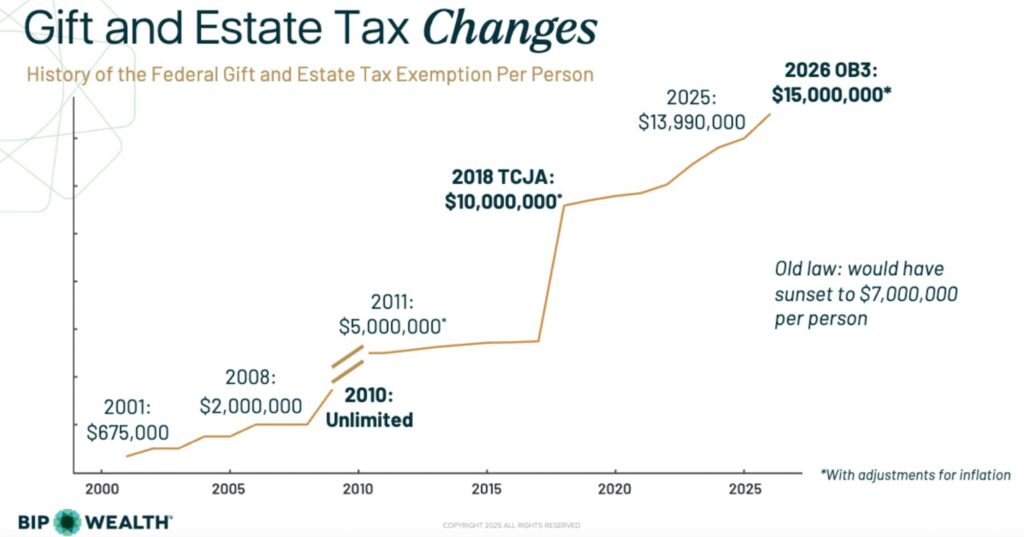
The impacts of these changes are clear. If your estate is worth under $7 million, or $14 million as a married couple, your estate planning strategies should remain largely unchanged. If your estate is worth between $7 million and $15 million ($14 million and $30 million as a married couple), you are now safer from estate taxes than ever before. If your estate is worth more than $30 million, your strategy would remain largely unchanged. As always, it’s important to regularly consult your tax advisor to ensure your plan continues to adapt to changing financial regulations.
Where the new laws bring a plethora of changes is with personal income tax. Now, this bill was pushed through by Congress. Now, it is up to the IRS to implement each change. OB3 continues a lot of the shifts made in 2017, which at the time was the most significant tax reform since 1986. To set the record straight, Social Security benefits will remain taxable. There were rumors in the media that this was going away, but up to 85% of your future benefits will still be included in your taxable income. That remains unchanged.
The income tax brackets from 2017 also remain the same, giving working families a bit more security in knowing they’ll likely not be paying more in 2026 and the years to come.
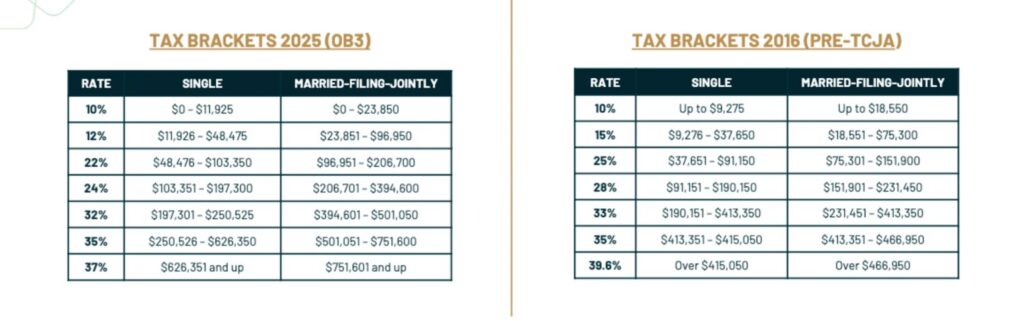
Additionally, the standard deduction for taxes remains much higher, with up to $15,000 for individuals and $30,000 for married-joint filings. This can be used for medical expenses, property taxes, charitable contributions, and more.
Now, what will be changing? The short answer is quite a bit. The State and Local Tax Cap (SALT) for individuals has increased from $10,000 to $40,000. While this law phases out higher earners of $500,000 or more, it will allow you to potentially enjoy higher itemized deductions until 2030. On top of this, Trump Accounts will now be opened for kids born from 2025-2028. The federal government will make an initial $1,000 deposit, with up to $5,000 in annual after-tax contributions until the child reaches 18 years of age. Growth is tax-deferred, with early withdrawals after age 18 subject to a 10% penalty. However, many questions remain about how these accounts will work, what will be sunset in the future, and the overall mechanics, so be sure to discuss this with your tax advisor.
Additional changes include a $6,000 deduction for taxpayers 65 years and older, expansions to eligible expenses for 529 funds, and no taxes on overtime and tips up to $25,000. For business owners, the bill also allows for an alignment of tax-deductible expenses with cash flow, plus the potential for significant capital gains savings through company stock.
If you have any questions about the new OB3 laws or need to take a closer look at your current estate plan, contact the BIP Wealth team today!
Disclaimer: This is a very high-level overview of some of the important aspects of the new tax law. It's intended for general informational purposes, and it's not intended to constitute tax, legal or investment advice, so if you need or want tax, legal or investment advice, please consult your personal tax professional or estate planning attorney before making any decisions.
