A Spousal Lifetime Access Trust (SLAT) is an estate planning strategy often used by high-net-worth families to move appreciating assets out of a taxable estate while still allowing a spouse to benefit from those assets during their lifetime. SLATs can offer estate tax mitigation, gifting flexibility, and asset protection benefits, but they also come with important risks tied to divorce, premature death, liquidity planning, and complex trust structuring.
For families with significant wealth, estate planning eventually becomes about more than basic wills and powers of attorney. Once a household approaches estate tax exposure, advanced strategies often enter the conversation, and one of the more common tools is the Spousal Lifetime Access Trust.
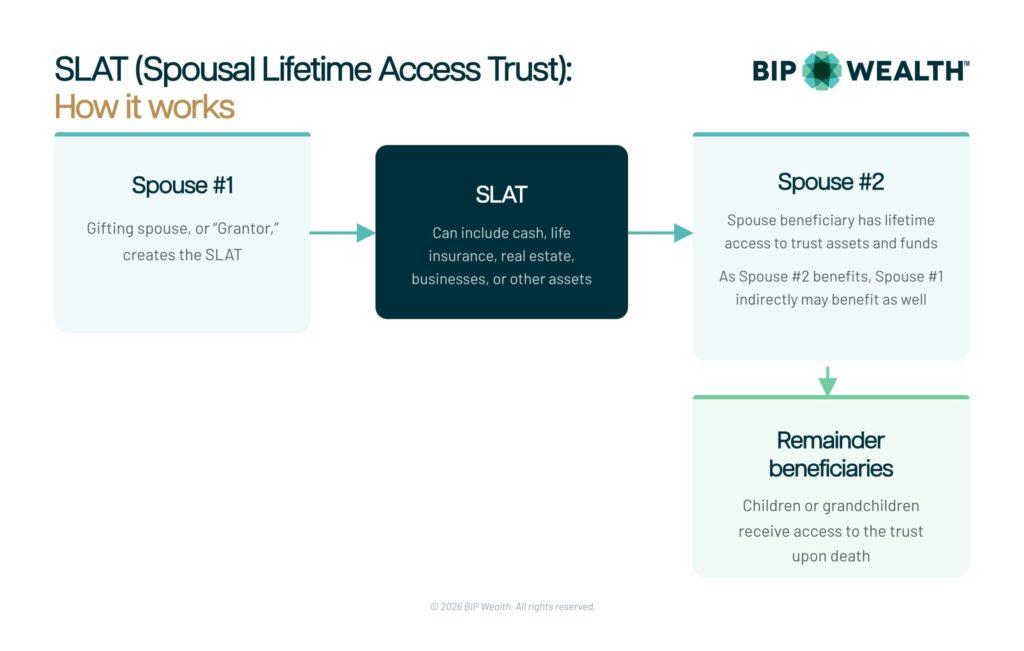
A Spousal Lifetime Access Trust (SLAT) is an irrevocable trust created by one spouse for the benefit of the other spouse, typically alongside children or future generations. The primary goal is to move assets outside of the taxable estate while still preserving a degree of indirect household access to those assets.
Check out this Spousal Lifetime Access Trust diagram for a helpful visual:
In practice, this allows a family to transfer wealth strategically while maintaining some flexibility if future cash flow needs arise.
SLATs easily become part of a holistic wealth management strategy that coordinates investment management, tax planning, estate planning, and long-term liquidity needs.
The structure itself is highly technical from both a legal and tax perspective, typically requiring estate attorneys, CPAs, and wealth advisors to assist with planning.
At a high level:
Assets commonly transferred include:
Because the assets are removed from the grantor’s taxable estate, future appreciation may also avoid estate taxes.
SLATs are often discussed with families whose estates may eventually exceed the $30M combined estate tax exemption available to a couple.SLATs are often discussed with families whose estates may eventually exceed the $30M estate tax exemption threshold. In many cases, clients exploring SLATs have net worths exceeding $15 million and are beginning to ask bigger-picture questions like, “You said I may have an estate tax problem. What can we do about it?”
A SLAT is one option within that broader estate tax planning toolbox.
A SLAT is usually not an early-career planning strategy. More often, these conversations happen later in life—families in their 50s or older, business owners with appreciating assets, or couples who have been married for decades and already have foundational estate documents in place.
In many cases, the strategy is best suited for:
This is especially true for families already focused on protecting wealth for children and future generations through long-term family and individual planning.
While there are many benefits, there are some potential risks associated with SLATs. Here’s a look at them.
The primary benefit of an SLAT is that it reduces future estate tax exposure by removing appreciating assets from the taxable estate.
Although the grantor gives the assets away, the beneficiary spouse may still access trust distributions under the trust terms.
While not usually the primary objective, SLATs may also provide a layer of creditor protection depending on the trust structure and state law.
SLATs can help families move wealth efficiently to future generations while maintaining continuity in the overall financial plan.
If the beneficiary spouse is no longer part of the household, indirect access to those assets may effectively disappear, and it would be encouraged to work with a Certified Divorce Financial Analyst.
That said, many families pursuing SLATs are long-married couples with stable financial structures, reducing the likelihood of this outcome. so this concern is not very common.
An unexpected life event, such as premature death, can also fundamentally change the structure.
If the beneficiary spouse dies first, children often become the primary beneficiaries. That may create a scenario where adult children ultimately stand to benefit from control assets that may have once supported the surviving spouse’s lifestyle.
A SLAT is irrevocable. The grantor is permanently transferring ownership of those assets.
That means liquidity planning matters. If you gift $10 million into a trust, the assets remaining outside the trust still need to support your long-term lifestyle.
Couples sometimes create SLATs for each other, but if the trusts are too similar, the IRS may apply reciprocal trust rules that undermine the intended tax treatment.
This is one reason why drafting and customization are critically important.
Modern trust planning often includes multiple “levers” built into trust documents to preserve flexibility as laws, tax rules, and family dynamics evolve.
But even with that flexibility, a SLAT should never exist in isolation.
The strategy works best when coordinated with:
For families navigating substantial wealth, the goal should be to build a durable financial structure that can support multiple generations while adapting to life’s inevitable changes.
At BIP Wealth, your estate plans are integrated into a holistic plan centered around planning for unexpected life events, investment strategy, and long-term family goals. If you’re interested in an SLAT or want to discuss your portfolio strategy, connect with an advisor today.
BIP Wealth, LLC (“BIP Wealth”) offers investment advisory services and is registered with the U.S. Securities and Exchange Commission (“SEC”). Registration with the SEC as a registered investment adviser does not imply a certain level of skill or training. This blog is intended for informational purposes only and is intended solely for the addressee. For more information about BIP Wealth, please refer to our Form ADV, available at adviserinfo.sec.gov or upon request.
This blog is intended for informational purposes only and does not constitute tax or legal advice. Please consult your personal tax professional and estate planning attorney before making any tax or legal decisions.
Investors should seek tax and legal advice based on your particular circumstances from an independent tax professional and estate planning attorney as laws are subject to interpretation, legislative change, and are unique to each individual’s particular set of facts and circumstances.
In the world of estate planning, where many concepts already feel slightly out of reach, Trusts can certainly challenge the mind. These structures fulfill various needs and goals and can be broken down into myriad categories. In this blog, we’ll answer common questions including: What is a trust? When do I need a trust? Does a trust save on taxes? Does a trust keep creditors away?
A trust is a legal structure in which a Trustee is designated to manage assets for the benefit of one or more Beneficiaries. The person who establishes and generally funds the trust is called the “Grantor” or “Settlor.”
Often, a trust is established to ensure assets are managed in a certain way and by a certain person or person(s).
There are many kinds of trusts that serve many different purposes.
One of the most common types of trusts is the Revocable Living Trust (“RLT”). In this type of trust, the Grantor, Trustee, and Beneficiary are usually the same person. The purpose of the trust is simply to remove the assets from the Grantor’s individual name to avoid Probate and to help ensure the smooth transition of assets in the event of incapacity or death. This type of trust is a great estate planning tool, but does not provide tax savings or creditor protection.
Alternatively, Irrevocable Trusts are often used for tax planning or asset protection purposes. These trusts can be established during life (an “Inter Vivos” or “Living” Trust) or upon death (a “Testamentary” Trust).
For example, during life one can establish and fund an Irrevocable Living Trust for the benefit of a spouse, children, and / or grandchildren, in order to move assets out of the taxable estate and ensure the assets are protected for generations to come. Or, in a Will you can establish a trust for the benefit of your spouse and children which protects those assets from future creditors and liability, including divorcing spouses, after you have passed. This would be an Irrevocable Testamentary Trust.
Trusts can have an impact on income taxes (imposed on earnings) as well as gift and estate taxes (imposed on the transfer of wealth).
As far as income taxes are concerned, income generated by trust assets is still taxable, either to the Grantor, to the trust itself, or to a beneficiary or beneficiaries. Often, it is preferable that the Grantor be liable for income taxes because the trust is subject to compressed income tax brackets. In other words, taxes may be lower if the Grantor is still alive and is responsible for them.
In the event of a testamentary trust, the Grantor is deceased, so the income is either taxed to the trust or, in the event of a distribution to a beneficiary, can be taxed to the beneficiary.
Concerning Gift and Estate Taxes, a transfer of assets to an Irrevocable Trust created for (and controlled by) someone other than the Grantor may be a taxable gift that has to be reported and counted against a person’s “lifetime exemption.” The trust assets may then be able to grow outside of the Grantor’s taxable estate, and the appreciation can pass estate tax free. The typical Revocable Living Trust, on the other hand, has no gift or estate tax impact at all.
Some trusts are creditor-protected and some are not. Generally speaking, a revocable trust (one that the Grantor can change/amend/revoke) is not protected from the Grantor’s creditors because of the Grantor’s unrestricted access to Trust assets.
In a majority of states, creditors can also reach Irrevocable Trust assets if the Grantor is also the Beneficiary. That is, if I set up an Irrevocable Trust for my own benefit, my creditors can still reach them. However, a minority of states will protect the assets of these “self-settled” Irrevocable Trusts when structured properly under the laws of those states.
Irrevocable Trusts established for the benefit of someone else (e.g. my spouse or my child) can be protected from creditors – both the Grantor’s creditors and those of the beneficiary(ies).
An experienced estate planning attorney can answer both of these questions for you. Your attorney should consider your goals and evaluate whether a trust (and which kind of trust) is necessary to accomplish those goals. Trusts are certainly not a one-size-fits-all solution and many factors should be weighed.
If a Trust of any kind is necessary or helpful, the attorney would draft the trust document in a manner that is tailored to your needs and assist in the execution of the necessary documentation. The final step is to provide guidance and help transferring assets to the trust, by way of retitling accounts and executing deeds to trust for real property.
A note from Sarah: Trust planning is deeply personal, and the right structure for you depends on factors specific to your life, your family, and your goals. If any of these questions resonate with you, I’d encourage you to reach out.
At BIP Wealth, our team of trusted advisors can help clients like you evaluate whether a trust is advisable or necessary and connect you with professionals to help you put a comprehensive trust plan in place.
A will is a legal document that expresses your wishes for how your assets should be distributed after you die, but it has to go through probate, which is a court-supervised process that takes time and can be costly. A trust, on the other hand, holds your assets during your lifetime and transfers them to your beneficiaries outside of probate entirely. That means a faster, more private transition for your family. For most clients, the desire to avoid probate is the primary reason we explore whether a trust makes sense for them.
Generally, yes, but only for assets that are actually titled in the name of the trust. This is a detail that catches a lot of people off guard. A Revocable Living Trust is specifically designed to keep your estate out of probate court, but if you never transfer your accounts or property into the trust, those assets will still go through probate. Part of the process of setting up a trust is what’s called “funding” it, meaning retitling accounts and executing deeds so your assets are properly held by the trust.
It depends on the type of trust. A Revocable Living Trust does not provide creditor protection; because you can change or revoke it at any time, creditors can still reach those assets. An Irrevocable Trust, however, can offer meaningful protection, particularly when it’s established for the benefit of someone other than yourself, like a spouse or children. If you’re seeking creditor protection as a goal, that’s an important conversation to have with an estate planning attorney, as the rules vary significantly by state.
A will alone may be sufficient for someone with a straightforward estate, few assets, and no concerns about probate, taxes, or creditor exposure. But for clients with more complex situations—a blended family, significant assets, a child with special needs, business interests, or multi-state real estate—a trust often becomes an essential part of the plan. There’s no universal answer here, which is why I always encourage people to think through their specific goals before assuming one approach is right for them.
For a Revocable Living Trust, the trust becomes irrevocable at the grantor’s death—meaning it can no longer be changed. At that point, the successor trustee steps in to manage and distribute the assets according to the trust’s terms, without the need for probate court involvement. For an Irrevocable Trust, the structure and administration at death depends on how it was originally drafted. In either case, having a clear, well-drafted trust and a trustee who understands their responsibilities makes an enormous difference in how smoothly things go for your family.
Sarah Watchko is an employee of BIP Wealth and has been serving families’ estate planning needs for nearly 20 years. This content is for informational purposes only and does not constitute legal, financial, or tax advice. Readers should consult with a qualified estate planning attorney before making any decisions related to estate planning.
Signed into law on July 4, 2025, the One Big Beautiful Bill Act, OB3 for short, offers comprehensive tax reform that will take effect on January 1, 2026. To help BIP Wealth clients better understand the new laws, our in-house Estate Planning Attorney, Sarah Watchko, and Tax Advisor, CPA, Allie Powell, teamed up to present a recent webinar. In this recap, we’ll review the key points of their presentation, breaking down what changed and what remained unchanged in our tax laws.
The webinar started with an iconic quote from Benjamin Franklin: “Our new Constitution is now established and has an appearance that promises permanency; but in this world nothing can be said to be certain except death and taxes.” Simply put, while these new tax laws come with changes for now, reforms in the future are to be expected, as tax laws are inherently political. So, what do you need to know about the One Big Beautiful Bill Act? In this blog, we’ll break it down for you.
While we could analyze the entire bill word-for-word, we decided to break our webinar into two main categories: Gift & Estate Taxes and Personal Income Taxes. In each section, we discussed what changed vs. what remained the same, compared to the significant reforms passed in the 2017 Tax Cuts & Jobs Reforms Act.
To start, let’s break down what remained the same. Overall, most of the laws surrounding gift & estate taxes remained the same on the federal level. While specific states may have their own estate taxes, portability, annual exclusions, and the basic framework of the 2017 reforms have all been left untouched.
The one big change comes with transfer tax exemptions. Now permanently set at $15 million ($30 million for a married couple), this allows you to transfer assets to a loved one without any taxes being imposed on your estate. For example, if you have $1 billion in assets and gift it all to your spouse during your life, this will not go towards the exemption amount. Plus, with portability remaining unchanged, if the $1 billion is left to your spouse, they can take the $15 million in exemptions with them, thus giving you the $30 million.
Another key tax law that remains unchanged is the annual exclusion. Another way to think about this concept is that the IRS doesn’t want to keep tabs on all of your birthday presents. As of the 2025 fiscal year, any gifts up to $19,000 can go tax-free. And there are no limits on the amount of gifts you can give up to the $15 million exemption.
The chart below tracks how the total exemption amount has increased over time, from just $675,000 per person in 2001.
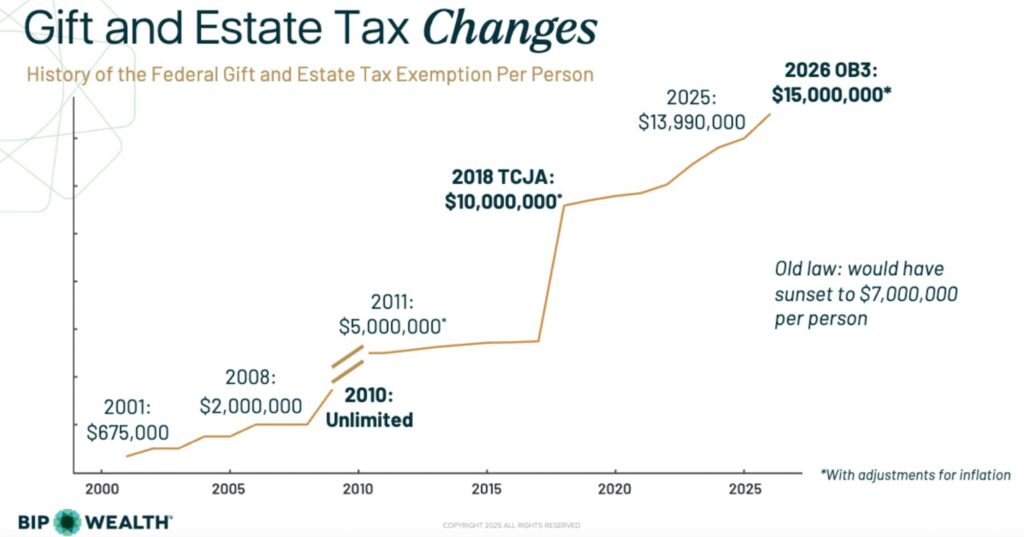
The impacts of these changes are clear. If your estate is worth under $7 million, or $14 million as a married couple, your estate planning strategies should remain largely unchanged. If your estate is worth between $7 million and $15 million ($14 million and $30 million as a married couple), you are now safer from estate taxes than ever before. If your estate is worth more than $30 million, your strategy would remain largely unchanged. As always, it’s important to regularly consult your tax advisor to ensure your plan continues to adapt to changing financial regulations.
Where the new laws bring a plethora of changes is with personal income tax. Now, this bill was pushed through by Congress. Now, it is up to the IRS to implement each change. OB3 continues a lot of the shifts made in 2017, which at the time was the most significant tax reform since 1986. To set the record straight, Social Security benefits will remain taxable. There were rumors in the media that this was going away, but up to 85% of your future benefits will still be included in your taxable income. That remains unchanged.
The income tax brackets from 2017 also remain the same, giving working families a bit more security in knowing they’ll likely not be paying more in 2026 and the years to come.

Additionally, the standard deduction for taxes remains much higher, with up to $15,000 for individuals and $30,000 for married-joint filings. This can be used for medical expenses, property taxes, charitable contributions, and more.
Now, what will be changing? The short answer is quite a bit. The State and Local Tax Cap (SALT) for individuals has increased from $10,000 to $40,000. While this law phases out higher earners of $500,000 or more, it will allow you to potentially enjoy higher itemized deductions until 2030. On top of this, Trump Accounts will now be opened for kids born from 2025-2028. The federal government will make an initial $1,000 deposit, with up to $5,000 in annual after-tax contributions until the child reaches 18 years of age. Growth is tax-deferred, with early withdrawals after age 18 subject to a 10% penalty. However, many questions remain about how these accounts will work, what will be sunset in the future, and the overall mechanics, so be sure to discuss this with your tax advisor.
Additional changes include a $6,000 deduction for taxpayers 65 years and older, expansions to eligible expenses for 529 funds, and no taxes on overtime and tips up to $25,000. For business owners, the bill also allows for an alignment of tax-deductible expenses with cash flow, plus the potential for significant capital gains savings through company stock.
If you have any questions about the new OB3 laws or need to take a closer look at your current estate plan, contact the BIP Wealth team today!
Disclaimer: This is a very high-level overview of some of the important aspects of the new tax law. It’s intended for general informational purposes, and it’s not intended to constitute tax, legal or investment advice, so if you need or want tax, legal or investment advice, please consult your personal tax professional or estate planning attorney before making any decisions.
