
Welcome to our 2026 Annual Market Report with Eric Cramer, CFP®, CFA®, BIP Wealth’s Chief Investment Officer. For this year's presentation, Eric starts with an honest scorecard of how BIP's 2025 investment themes played out, recaps what happened in markets around the globe, and makes the case for why the economic landscape is shifting in ways that matter for your portfolio.
In case you missed the live presentation, we've summarized Eric's main talking points below. You can also watch the recording of the presentation below.
Eric opened by going back to the four key investment themes BIP Wealth identified for 2025 and gave an honest accounting of how each played out.
Eric acknowledged this one made BIP Wealth CEO Bill Harris a little bit nervous when he used the word crash—but Eric’s reasoning was sound. A lot of tech and crypto exposure was leveraged, and as we saw during the housing crisis, leverage in any direction can be a real problem.
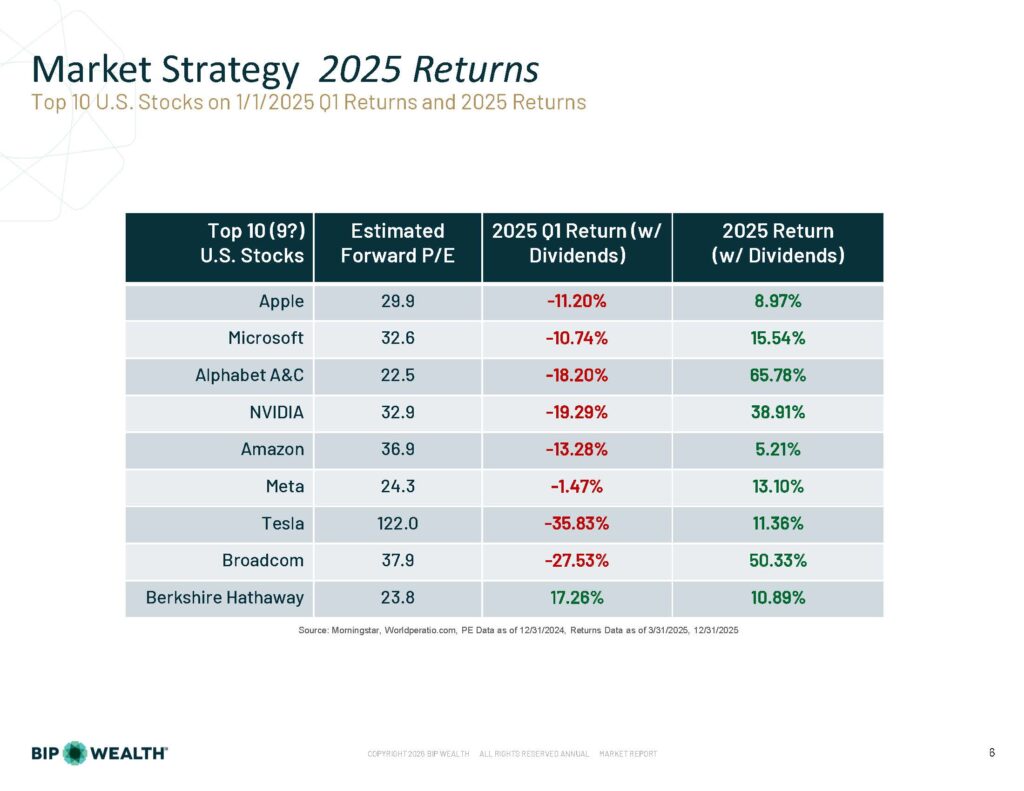
By the end of Q1, it looked like Eric was going to be right—and he admitted he honestly was not excited about that. Tech stocks got hit hard in the first quarter. Tesla fell 35.83%. NVIDIA fell 19.29%. But then something remarkable happened: markets turned the corner and several of those same stocks came roaring back. Alphabet, for example, went from down 18% in Q1 to up more than 65% for the full year. Berkshire Hathaway flipped the other direction, shining in Q1 when tech was falling, then giving some of that back over the remaining three quarters.
The ultimate verdict? "We kinda got close to a crash," Eric said, “but crash is probably too strong a word." It was a significant downturn followed by a remarkable recovery.
Source: Morningstar, Worldperatio.com, PE Data as of 12/31/2024, Returns Data as of 3/31/2025, 12/31/2025
The public stock market's top 10 stocks represented about a third of the entire market's value at the start of 2025—and even a little more by the end. While most investment managers typically think of diversification in terms of the public markets, Eric made the case for private markets as the most meaningful diversification tool available.
On the private equity side, Eric shared compelling data: over longer periods, private equity has delivered returns roughly four percent higher per year than public equity. And crucially, the two asset classes don't move in lockstep—which means holding both yields lowers volatility than holding either one alone, as the markets are not directly correlated.
He also highlighted a significant change in how investors can access private markets. The traditional model—committing to a fund, experiencing years of capital calls, then waiting another decade for your money back—is giving way to a new breed of vehicles called Evergreen Funds, including BDCs and interval funds. These allow you to put money in when you want and request liquidity in advance of when you need it. Eric called this a game changer for us and for you and noted that the newest versions have little to no paperwork.
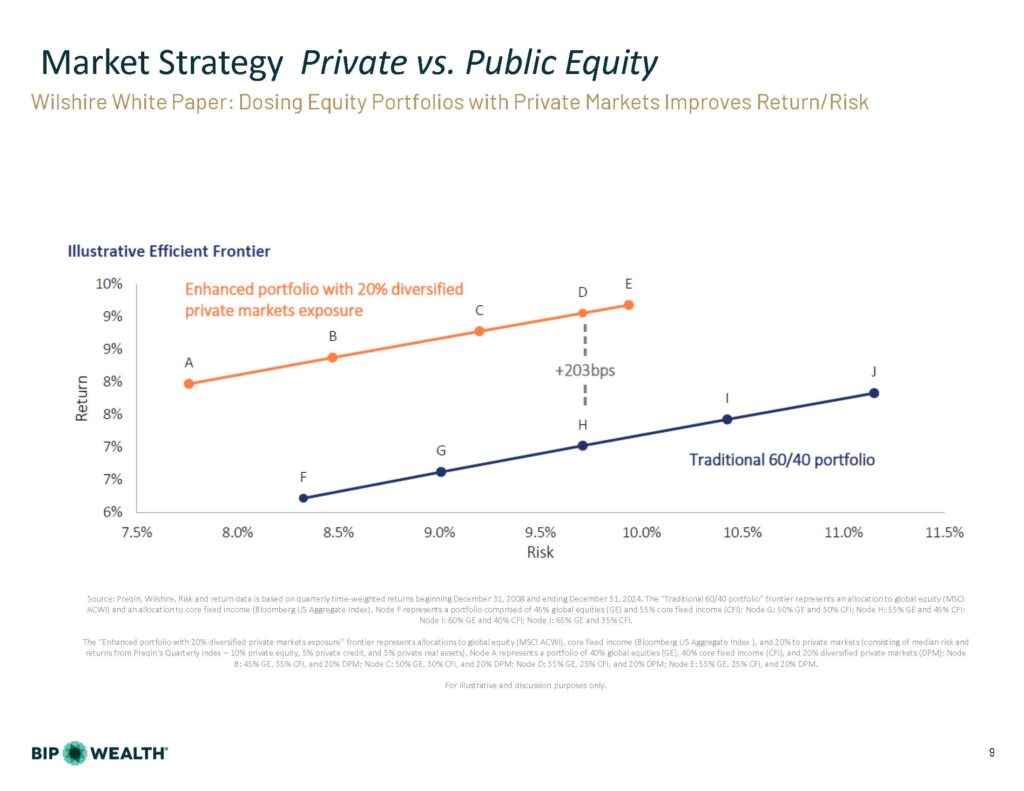
Source: Preqin, Wilshire. Risk and return data is based on quarterly time-weighted returns beginning December 31, 2008 and ending December 31, 2024. The “Traditional 60/40 portfolio” frontier represents an allocation to global equity (MSCI ACWI) and an allocation to core fixed income (Bloomberg US Aggregate Index). Node F represents a portfolio comprised of 45% global equities (GE) and 55% core fixed income (CFI); Node G: 50% GE and 50% CFI; Node H: 55% GE and 45% CFI: Node I: 60% GE and 40% CFI; Node J: 65% GE and 35% CFI.
The “Enhanced portfolio with 20% diversified private markets exposure” frontier represents allocations to global equity (MSCI ACWI), core fixed income (Bloomberg US Aggregate Index ), and 20% to private markets (consisting of median risk and returns from Preqin’s Quarterly Index – 10% private equity, 5% private credit, and 5% private real assets). Node A represents a portfolio of 40% global equities (GE), 40% core fixed income (CFI), and 20% diversified private markets (DPM); Node B: 45% GE, 35% CFI, and 20% DPM; Node C: 50% GE, 30% CFI, and 20% DPM; Node D: 55% GE, 25% CFI, and 20% DPM; Node E: 55% GE, 25% CFI, and 20% DPM. For illustrative and discussion purposes only.
Eric noted he was pleased to see that many BIP Wealth clients got their financial plans updated in 2025. This remains a core part of the BIP approach: there are often risks that can be identified and mitigated with the right plan in place. No further commentary needed — just a strong endorsement to keep your plan current.
The era of earning inflation-beating returns on the safest possible assets has narrowed significantly. Short-term treasuries are currently yielding around 3.6%, and Eric doesn't expect the Federal Reserve to lower rates for much of, or possibly all of 2026. They held at the last meeting, and the futures market puts any cut likely at mid-year at the earliest. He noted there's even a scenario where rates could move higher.
For clients in high tax brackets holding treasuries in taxable accounts, the margin over inflation has become thin. That's led BIP to look more closely at municipal bond strategies, which Eric described as increasingly attractive. Because so many states have balanced budget requirements, he went as far as suggesting that munis may be the new treasuries in terms of safety.
Someone told Eric that 2025 felt “a bit like surgery without anesthesia.” The year was packed with headlines: tariff announcements, geopolitical moves, government shutdowns, market swings. But if you missed the news and just looked at the value of your investment accounts, you might have blinked and missed the fact that there was even a downturn. Markets dipped on tariff news early in the year and came right back. This is the third consecutive year of a strong global stock market, and Eric noted that for many clients, their own balance sheets are about as big as they've ever been.
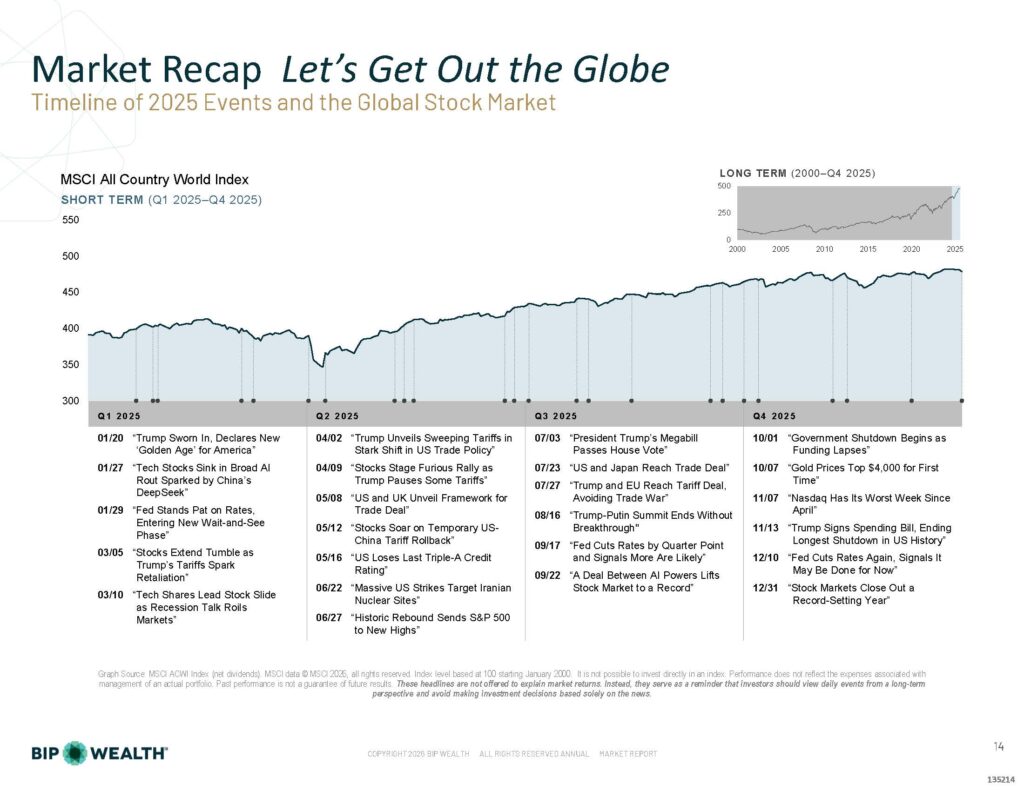
Source: MSCI ACWI Index (net dividends). MSCI data © MSCI 2026, all rights reserved. Index level based at 100 starting January 2000. It is not possible to invest directly in an index. Performance does not reflect the expenses associated with management of an actual portfolio. Past performance is not a guarantee of future results. These headlines are not offered to explain market returns. Instead, they serve as a reminder that investors should view daily events from a long-term perspective and avoid making investment decisions based solely on the news.
Even though the U.S. stock market had a terrific year—returning 17.15%—the best returns in 2025 came from outside the country. International developed market stocks returned 31.85% for the year. Emerging market stocks returned 33.57%, nearly double what the U.S. produced.
A big part of the story is the weakening U.S. dollar. When the dollar weakens, foreign currencies strengthen. And when you invest in overseas equity markets, you're really investing in both a foreign stock market and a foreign currency. When both go up together, you get the compounded effect of those two phenomena. That's how you get these impressive international numbers.
It's worth noting, however, that a weaker dollar cuts both ways. It can help U.S. manufacturers whose goods become cheaper overseas, but it makes imported goods more expensive for the rest of us. More dollars to buy the same goods: that's the definition of inflation.
Eric warned this section would feel a little bit like an econ class, but the material is important, and he walked through it in a way that's worth unpacking.
One of the more fascinating and underappreciated dynamics affecting global markets right now is what's happening in Japan. For decades, Japan had ultra-low or even negative interest rates. Home safes became popular in Japan because at least your money didn't shrink sitting in a safe. But in a negative rate environment, sophisticated financial players could borrow in Japanese yen for next to nothing, invest in U.S. Treasuries at 4%, and pocket a comfortable margin. This was the Japanese carry trade, and it reached into the trillions of dollars across decades.
That trade has more or less evaporated. Japan's interest rates have skyrocketed, borrowing costs are far higher, and the margin that made the trade profitable is gone. This is a real problem and it's one reason why the U.S. could see pressure to intervene in currency markets, which would further weaken an already weakened dollar.
The consumer confidence data tells a nuanced story. The "present situation" index is holding up better than the "expectations" index—both trending downward, but the present looks better than the future. Eric noted he often encounters this disconnect in conversations with clients: "I'll ask them how they're doing, and they may talk about pessimism about the economy. But when we get down to how they're doing personally, they're often doing great."
Part of what explains that gap is who drives consumer spending. The top 20% of earners are responsible for about half of all consumer spending in the U.S.
Here's a concept worth sitting with: Eric learned in business school that the stock market reflects the state of the economy. But he thinks that may have flipped. Today, if the stock market is doing well and your balance sheet is at record highs, you feel good about spending—and the economy follows. The tail is wagging the dog.
For those in the top tier of earners and asset holders, this dynamic is likely to persist. If there's a problem with interest rates and the Fed has to come to the rescue printing money, if you've got an investment portfolio, you're probably going to be fine.
Looking ahead, BIP Wealth has identified four themes that will shape our investment approach this year:
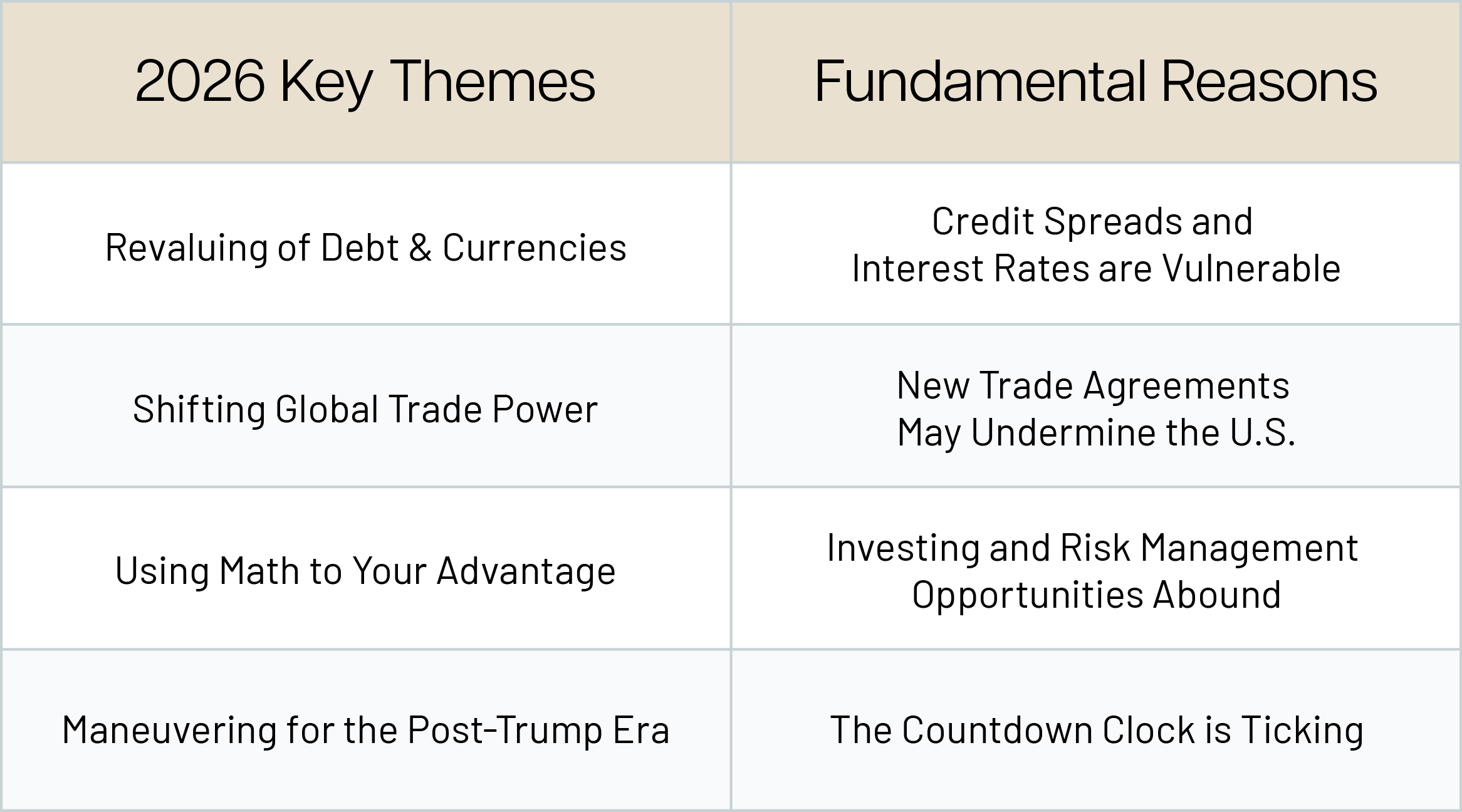
Eric closed with a broader perspective on the moment we're in. The world is changing fast—AI, global trade, geopolitics—and that's changing the landscape for investing in ways that require expertise and attention to evidence rather than headlines.
America is divided, economically as much as politically. The bottom half of Americans don't own a share of stock. The top earners hold most of the assets and drive most of the spending. For BIP Wealth clients, that divide is actually somewhat protective, but it also creates instability that we need to plan around.
"BIP Wealth is dedicated to using the best evidence available to help you meet your financial goals in a future that doesn't look like the past," Eric said. "This is when expertise and insight matter most."
Don't be surprised if your Personal Wealth Advisor brings new ideas to your next conversation. BIP Wealth is actively building and deploying new tools to help clients navigate everything this year may bring. If you'd like to speak with an advisor about your portfolio or learn more about how our 2026 themes might affect your financial plan, talk with a BIP Wealth advisor.
This communication contains general investing information that is not suitable for everyone and is subject to change without notice. Past performance is no guarantee of future results and there is no guarantee that any views and opinions expressed will come to pass. The information contained herein should not be construed as personalized investment advice, tax advice, or financial planning advice, and should not be considered a solicitation to buy or sell any security. Investing in the stock market and the bond market involves gains and losses and may not be suitable for all investors. Indices are not available for direct investment. Certain private market investments are subject to qualification thresholds and are subject to significant risks, including liquidity risk.
At BIP Wealth, financial literacy is not about predicting markets or chasing the hottest trends. It’s about equipping people with the confidence to make informed decisions, especially during periods of uncertainty. Our latest financial literacy workshop focused on one idea: strong financial outcomes begin with understanding the fundamentals.
Led by CJ Young, CFP®, the session brought together young adults and college students who are navigating new financial responsibilities. Rather than offering rigid rules or one-size-fits-all advice, the financial literacy workshop centered on practical frameworks attendees could apply immediately and adapt over time.
What followed was a candid, grounded conversation about money rooted in clarity, preparation, and long-term financial wellness.
Below is a recap of the key topics and takeaways shared during the event.
Five themes for improved financial literacy:
These topics are very common to have questions about, and affect us in the present, thus setting us up for the future. But the thread that connects them all is that financial progress comes from strategic planning, not perfection.
Here are each of those themes broken down to help you build towards long-term financial wellness.
Building a budget is a core element of financial responsibility. If nothing else, we must know where our money is going, and if necessary, what we can afford to drop to make sure that we spend less than we make. The most important thing to remember is that a budget isn’t about restricting yourself, but providing clarity about what’s ahead.
One of the more common budgeting strategies is the 50/30/20 rule. Here is what that looks like in practice:
With this type of budget, you can always be flexible with how much of your income you want to delegate to each tier. For example, you may want to adjust these percentages to reflect your personal priorities, variable income, or aggressive savings goals.
Overall, the 50/30/20 budget rule makes sure that your needs, savings, and investments come first, and what’s left over can support your wants.
If you’re looking to build or refine a budget, check out this 50/30/20 budget calculator.
Another important topic is emergency fund planning, particularly for financial stability and peace of mind.
An ideal emergency fund typically covers three to six months of essential expenses and is reserved for true emergencies, such as:
Effective emergency fund planning isn’t just about saving your money, but making sure that it’s accessible. While traditional savings accounts are common, options like high-yield savings accounts or money market funds may offer better interest while maintaining liquidity.
Credit card usage is often a major source of financial confusion for younger generations, especially when it comes to interest rates, minimum payments, and long-term costs.
When used responsibly, credit cards can support financial wellness by building credit and offering rewards. However, when misused, they can quietly erode your progress.
One of the most practical credit card tips is to treat your credit card like a debit card. Only spend money you already have and plan to pay off every single month.
Many cards carry interest rates above 20%, with some nearing 30%. Making only your minimum payment can not only stall paying off your card in full, but also cause you to pay even more in interest. This essentially leaves you with a higher balance than you started with.
If you’re looking for a tool to help with calculating your minimum payments, check out Bankrate’s Minimum Payment Calculator.
Here are some common credit card mistakes to look out for:
Not all debt is bad!
Mortgages, car loans, and credit cards are all common forms of debt that can help you prove you are financially responsible. That’s why paying in cash is not always the best option; responsible debt can actually help you build credit and flexibility.
Debt becomes a problem when:
The decision between buying and renting is often framed as a one-size-fits-all answer. In reality, it’s a personal choice that depends on timing, stability, and long-term financial wellness goals.
Rather than focusing on what you should do, it’s more helpful to understand when each option tends to make sense and how it aligns with your current season of life.
Buying a home can be a great option when you have clarity around your plans and are thinking long-term.
Buying is less about market timing and more about readiness and commitment. Here are things to consider about buying a home:
Renting offers flexibility, which can be especially valuable during periods of change or uncertainty.
Renting may make more sense when:
Knowing the investing basics is incredibly important for long-term planning. But the most important “basic” to understand is to start investing NOW!
By investing at a young age, there’s more time on your side. This means you can take on more risk than those who are nearing retirement.
Although all investing involves risk, a person who invests in index funds tracking the stock market has historically been rewarded over time. Since 1957, the S&P 500 has averaged an annual rate of return just over 10%.
For many people, investing begins with opening an account at a brokerage firm. These accounts allow you to invest in stocks, bonds, and index funds based on your goals and comfort with risk.
Common brokerage firms include:
These platforms provide tools and resources that help you get started without needing to manage everything on your own.
A 401(k) is a retirement account offered through an employer that allows employees to contribute a portion of their paycheck toward long-term savings. Many employers offer matching contributions, which can significantly accelerate retirement growth over time.
Contributions are typically automated, making it easier to invest consistently and build disciplined habits early in your career.
An Individual Retirement Account (IRA) is another common way to invest for retirement outside of an employer plan.
There are two primary types:
Choosing between the two often depends on income, tax considerations, and expectations about your future earnings.
The Rule of 72 demonstrates how a young investor can build a disciplined approach to investing. By practicing this rule, you can grow your assets over a long period of time while putting a modest amount of money away each month, quarter, or year.
To use the Rule of 72: Divide 72 by your expected annual return. For example, at a 10% return, an investment could double in approximately 7.2 years.
If you’re interested in seeing how far your investments could go in preparation for retirement, check out this retirement calculator from Ramsey Solutions.
Everything we have covered can be a lot to take in when you’re just getting started. Here are six things to prioritize now:
The financial literacy workshop reinforced one of our core beliefs: long-term financial confidence is built through clarity, preparation, and intentional decision-making.
Unfortunately, there are no shortcuts or guarantees to your financial goals. But with strong budgeting strategies, thoughtful emergency fund planning, responsible credit card tips, and a clear understanding of investing basics, you can strengthen your overall financial wellness over time, leaving you with less stress in the future.
As Young shared throughout the session, financial literacy isn’t about knowing everything—it’s about knowing enough to take the next step with confidence.
Here are some great resources for you to take advantage of on your journey to financial wellness.
Want to further your education in financial literacy? Here are some books we recommend.
Stanley, Thomas J, and William D Danko. The Millionaire Next Door. Taylor Trade Publishing, 1996.
Cousineau, Jake. How to Adult: Personal Finance for the Real World. Jake Cousineau, 2021.
“Emergency Fund: Why You Need One.” Vanguard, investor.vanguard.com/investor-resources-education/emergency-fund/why-you-need-one.
“Credit Card Minimum Payment Calculator.” Bankrate, www.bankrate.com/credit-cards/tools/minimum-payment-calculator/.
“The Rewarding Distribution of US Stock Market Returns.” Dimensional Fund Advisors, 4 Apr. 2025, www.dimensional.com/us-en/insights.
“Retirement Calculator.” Ramsey Solutions, www.ramseysolutions.com/retirement/retirement-calculator?srsltid=AfmBOoqHZ5iI7ebCQ5OXR_B0xKKZtHyn8Dq9I7UcIfSaetiCaVjnxU3J.
#FinancialLiteracy #InvestingBasics #BudgetingTips
Private Credit is a large and growing category in the private market investing landscape. With exits harder to come by lately, more companies are adding debt to their capital structure (for several reasons that include avoiding direct dilution of equity). The dramatic increase in importance of private credit to the funding of companies has also led to a proliferation of funding vehicles that investors might participate in. New managers are popping up almost daily, and new vehicle types are emerging too. Co-investments, drawdown funds, public BDCs, private BDCs, and now Interval Funds are all seeing growth. These vehicles are making it easier for retail investors to include private credit in their portfolios.
In the broader credit markets, several trends are unfolding that could have a negative impact on some parts of Private Credit.
First, base rates are falling. The Fed has now lowered the overnight rate, as it should, to remove us from a restrictive stance. Many private credit strategies use floating rate loans, so falling rates will naturally lower yields. Investors should keep in mind that their return is a combination of the yield and the always changing price. Minor fluctuations in price are normal, and investors can expect yields to be lower in 2026 than they were in 2025. The long end of the yield curve is falling too, as the Fed ends quantitative tightening (no longer dumping bonds on the market to decrease its balance sheet, which was draining liquidity out of the system). We are also near a multi-year low point for credit spreads, reflecting that investors are getting paid less to take credit risk.
The combination of new money coming into Private Credit, along with a changing rate structure and price for credit risk, will certainly influence Private Credit in the larger sense. But the devil is in the details, and broad pronouncements that read something like “private credit is in trouble” are not accurate, not helpful, and outright confusing to our clients.
At BIP, we believed this would eventually happen, and we welcome the market pressure. It’s our chance to prove we know what we’re doing. This is the perfect time to show how real knowledge is so much more valuable than just knowing the headlines. Our clients are counting on us at BIP Wealth to get this right. And we have already done our homework to make sure we have a variety of evergreen strategies that we expect to do well in a variety of economic conditions.
Business Development Companies are entities that meet certain regulatory requirements created in 1980 and are close-end funds that distribute 90% of income. We track about 3 dozen publicly traded BDCs, and 2025 returns through 12/31/25 range from +16.75% to -27.38%, with more in negative territory than positive. This is markedly different from the returns we are seeing in the vehicles we’re using, and you may notice that few survived the pullback in credit markets during 2022 unscathed.

BSLs tend to be of lower quality and lack the covenants and remedies that are the hallmark of our strategies. BSLs are originated by banks, securitized, and then traded daily. Some might equate this to juggling chainsaws when credit markets turn sour—you want to drop them as quickly as you can to avoid getting your hand cut off.
These are, by nature, not diversified. But here again, the details are important. Many are convertible notes, which in reality are equity deals that pay a yield to the investor and sit above other equity investments in terms of their priority. We have a long history of enjoying some of our best equity returns from these investments.
We expect to be able to prove to our clients that your trust in us is warranted. But this comes with the obligation to explain our prudent process in a world of scary headlines. If the risky end of the private credit market does start to experience significant stress, some of our clients may become concerned.
If you would like to learn more about our Private Credit strategies and if they might be a fit for you, the BIP Wealth team is here to help. Contact us today to be connected with a trusted advisor.
This post is provided for informational purposes only. Specific investments may not be suitable for all investors and no offer or recommendation of any investment or investing strategy is intended or implied by your choosing to read this post. Privately traded offerings may only be available to investors who meet certain qualification statuses.
This material is not intended to be relied upon as a forecast or investment advice regarding a particular investment or the markets in general, nor is it intended to predict or depict the performance of any investment. Past performance is no guarantee of future results. All investments involve risks including loss of principal.
If you have been consuming financial news this week, you will know the stock market has taken a bit of a plunge due to the tariffs announced on Wednesday afternoon. This comes on the heels of a volatile stock market in the first quarter. We wanted to give you BIP Wealth’s perspective on these recent events, although we are not ready to predict the final outcome.
We think the best way to understand what’s happening is to consider the actions of the four forces at play:
The current administration is using tariffs to re-write the economic relationship between the United States and other economies. For many years, other countries have imposed tariffs on U.S. goods and services that have been a bit lopsided against us. The U.S. has imposed its own tariffs on some imported goods in an effort to protect workers, while at the same time there have been numerous “free trade” agreements with favored nations. The history of tariffs goes back hundreds of years, but in more recent times the U.S. has emerged through it all as the world’s leading consumer economy of imported goods, while oftentimes struggling to export its own products while struggling with downward wage pressure at home. These newly announced tariffs are a powerful negotiating tool designed to leverage our consumer appetite and economic strength, but it is impossible to know where this will all settle out and when.
China has already announced retaliatory tariffs, although one could argue that the new U.S. tariffs were in retaliation for a massive trade imbalance that China protected. Over the next week we can expect to hear similar announcements from dozens of countries. This progression into a “trade war” could have a significant negative impact on the global economy, however many countries are expected to reach out to the Trump administration to negotiate. Some of these responses will likely be an effort to make the kind of “phenomenal offer” that President Trump has hinted he would be looking for. It is impossible to predict how this will end, but we will be watching to see the terms of the first few deals to see what it takes to settle these issues.
For the past year, the Fed has enjoyed owning what is often called the “Fed Put.” This is borrowing terminology from the options markets, and refers to the idea that if the economy gets in trouble then the Fed can respond by lowering interest rates to prevent a recession. However, this only works when inflation is contained. Generally speaking, when interest rates are lowered it can cause inflation to rise; and with the Fed having bungled this quite a bit in the post-pandemic era they will likely be slow to move. Today President Donald Trump called on the Fed to lower overnight rates immediately. But tariffs on imported goods are expected to double the rate of inflation in 2025 to perhaps a rate of 5%, so any move by the Fed that could make that worse is quite the gamble. The Fed has a mandate to foster full employment, stable long term interest rates, and low inflation; but it does not have a mandate to do exactly what is being asked of it now. It is impossible to know how the Fed will respond at this point, although we will be listening intently to find out.
For the moment, the idea of tariffs seems to enjoy broad support among working Americans. Many families have watched in frustration for decades as furniture, textile, and manufacturing jobs have been offshored. Real wage growth in non-technical jobs has been slow, and it is correct to think that globalization has worsened the economic fortunes for many Americans. At the same time, we have enjoyed the benefits of lower prices on goods manufactured in low labor cost countries in Asia and elsewhere. Wall Street voices have been highly critical of the scope and pace of the new tariff policies this week, but that group is simply not the President’s constituency. If we fall into a recession, and American unemployment spikes, it will likely be happening around the globe even worse.
Understanding the situation through these four forces may not give you any comfort right now. But this is how we see it, and we’re watching events unfold just like you. Let’s keep in mind that a relief rally could be upon us at any time, and it could be a big mistake to assume that the pace of the sell-off will simply continue.
In our Annual Market Report earlier this year we suggested some steps you could take to prepare for this kind of uncertainty. Click the link below to check out Eric Cramer’s Webinar from Q1…
As a reminder, here are our 4 Key Themes for 2025 and what we’ve seen so far:
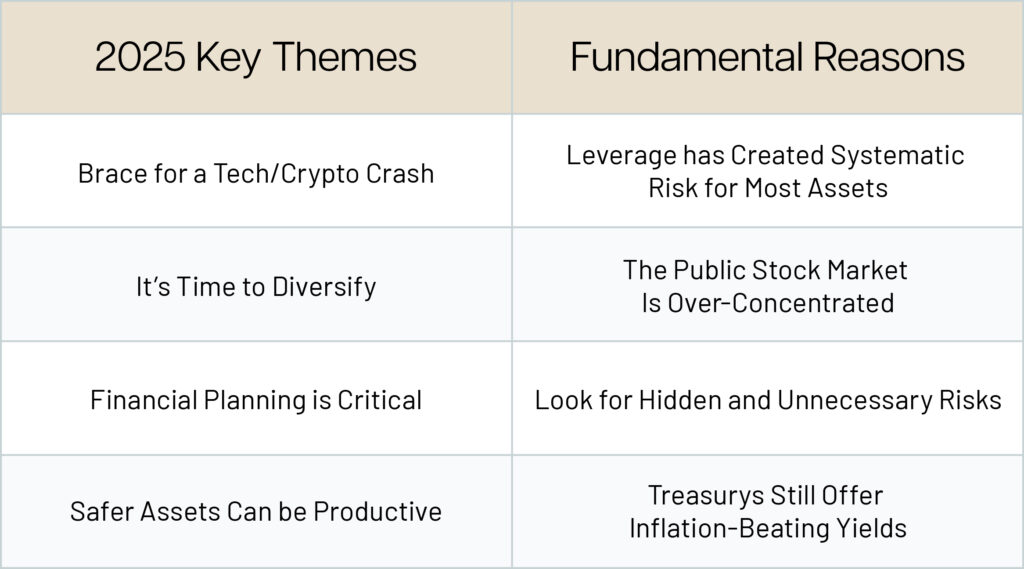
Brace for a Tech/Crypto Crash (Leverage has Created Systematic Risk for Most Assets)
Well, tech stocks did crash. We have strategies in place to help clients with large concentrations to mitigate risk.
It’s Time to Diversify (The Public Stock Market is Over-Concentrated)
We suggested that indexing would not be sufficient due to the concentration in public equities, and that using private credit in particular could be an effective way for many clients to possibly increase their expected return while lowering their expected risk.
Financial Planning is Critical (Look for Hidden and Unnecessary Risk)
We did our best to suggest that some clients may have more exposure to public equities than they “needed” to have. This was in addition to the other benefits of financial planning, such as risk mitigation through an insurance review.
Safer Assets Can be Productive (Treasurys Still Offer Inflation-Beating Yields)
We offer clients BIP Short-Term Tactical, which is our proprietary trading strategy providing an alternative to holding cash in banks. The primary goals of the strategy include achieving a rate of return higher than banks commonly offer, capital preservation, and liquidity, while mitigating risk.
While we can’t predict the future, we strongly suggest having a well-rounded financial plan. This is a great time to take a look at your particular situation and work with a BIP Personal Wealth Advisor so you can take advantage of all the tools we have at our disposal.
Thanks for reading, and please know that we will continue to update you as events unfold.
This post is provided for informational purposes only. Specific investments may not be suitable for all investors and no offer or recommendation of any investment or investing strategy is intended. The opinions in this commentary are as of the posting date and are subject to change. Information has been obtained from third-party sources we consider reliable, but we do not guarantee the facts cited are accurate or complete. This material is not intended to be relied upon as a forecast or investment advice regarding a particular investment or the markets in general, nor is it intended to predict or depict the performance of any investment. We may execute transactions in securities that may not be consistent with what is mentioned here. Investors should consult their financial advisor on the strategy best for them. Past performance is no guarantee of future results. All investments involve risks including loss of principal.
Author: Eric Cramer, CFP® CFA®
September’s strong jobs report surprised some, but we’ve been telling our clients the economy is fundamentally strong all year. The short version of what we learned with the release of the September jobs report is this: We added 254,000 jobs in September, which is much stronger than the 150,000 consensus forecast.
What does this mean for the economy?
It was widely reported in late August that the BLS had a massive revision downwards in job growth from 3/2023 to 3/2024 (they revise every year). They reduced the amount of job growth by 818,000 jobs, which is one of the largest downward revisions ever. This stoked concerns of a “jobs recession” even though employers are struggling to find workers and other data (such as job openings) confirm a generally strong labor market.
It was less widely reported that in September, real GDP through the end of 2023 was revised up by 1.2%, and 2024 Q2 was revised up .1%. This was mostly due to stronger consumer spending, a metric we have consistently tracked (while also debunking the notion that consumers had run out of money).
It looks like the Fed’s slow pace of lowering rates hasn’t pushed us into a recession. And the Weekly Economic Index (WEI predicts GDP) suggests we aren’t headed for a recession anytime soon.
What does this mean for interest rates?
The strong economy may mean the Fed will take its time lowering interest rates. Current futures pricing shows a 25 bps cut on 11/7 and another 25 bps cut 12/18. Inflation is generally under control, but if energy prices spike due to increased tensions in the Middle East this could affect the data. But it’s safe to expect that we can continue to earn a yield on the short end of the Treasury yield curve that is well above the rate of inflation, and that our Short-Term Tactical strategy will have a useful role to play in client portfolios for the foreseeable future.
At the same time, longer term yields are on the move upwards. If this continues, then we will eventually end up with a so-called “normal” yield curve where investors earn more than the rate of inflation across all terms (even though we haven’t seen much of this for decades). This would be great for investors and businesses, and is what we can expect if the Fed eventually gets to a neutral stance and lets markets be free. It wouldn’t be unreasonable to expect that by the end of 2025 we have the short end of the curve at about 3-3.5%, with the long end of the curve at 4-6%. But there is a lot going on in the world right now that could change the picture between now and then.
What does this mean for the stock market?
As we’ve been saying all year, a strong economy that doesn’t go into a recession suggests it’s a good time to be a stock market investor. A Fed that is lowering rates, and promises to lower them as much as needed to protect the economy, is called the “Fed Put.” We’ve got that right now, and that’s about all a stock market investor could hope for.
But that doesn’t mean there won’t be some companies that aren’t big losers. Individual stock volatility is still quite high, and we think that will continue. Macro events, along with changes in technology that include the emergence of AI as an essential business tool, will re-order the competitive landscape. Many billions of dollars are being invested in innovation all over the world, and especially in the U.S. This isn’t happening in a vacuum—it’s happening with the explicit intention of changing which companies win, and which fall by the wayside. That makes it a good time to be diversified, and for many investors a good time to look at investment strategies like our Concentrated Stock strategy to manage risk.
This quarter's theme is, "How to Prepare for Market Disruptions." Listen in as BIP Wealth's Chief Investment Officer, Eric Cramer, covers what's going on in the financial markets and how we're advising our clients.